

TL;DR
- Order window: Chinese New Year falls on 6 February 2027. For stock in the UK by early March, approve samples and confirm your order by mid-to-late October 2026.
- Materials: powder-coated aluminium (with or without HDPE rattan) is the low-maintenance default for UK gardens; steel is cheaper but rusts where the coating chips; hardwood needs oiling and timber due diligence.
- Where it is made: Foshan (Guangdong) for design-led and contract ranges; Ningbo, Yuyao and Linhai (Zhejiang) for high-volume aluminium sets and parasols.
- Specify, then inspect: coating thickness (at least 60 microns on aluminium), HDPE rather than PVC weave, solution-dyed cushion fabric, stainless fixings and drop-tested packaging.
- UK rules: upholstered garden furniture that can be used indoors falls under the UK furniture fire safety regulations; timber falls under the UK Timber Regulations; duty depends on the commodity code.
- Shipping: order knock-down (KD) packing and plan six to seven weeks port to port while ships divert around the Cape of Good Hope.

Introduction
If you sell garden furniture in the UK, next spring’s range is decided now. Most of it is made in China, the selling season is short, and the factories close for Chinese New Year just as UK buyers need their containers on the water.
This guide is for retailers, wholesalers and brands planning a spring 2027 range. It covers when to order, which materials hold up in a British garden, where the factories are, what to check before goods leave China, and the UK rules that apply. For the wider furniture import process, see our guide to importing furniture from China.
1) Why the Spring 2027 Order Window Closes in October
Chinese New Year 2027 falls on 6 February 2027. As our factory shutdown calendar for Chinese New Year 2027 explains, the official holiday runs from about 5 to 12 February, but production slows from mid-January and many factories take two to four weeks to return to full output afterwards. For a seasonal product, that gap lands at the worst possible moment.
Work backwards from the date you need stock in the UK. The example below assumes you want containers in a UK port by early March 2027, ahead of the spring selling season.
Worked Example: Spring 2027 Garden Furniture Timeline
| Step | Latest date for early-March arrival | What to watch |
|---|---|---|
| Samples approved, PO signed, deposit paid | Mid-to-late October 2026 | Items with 75–90 day production need the earlier end of this window |
| Production | Late October 2026 to early January 2027 | Garden furniture is often quoted at 45–90 days; confirm per item and per factory |
| Pre-shipment inspection | Early January 2027 | Book before the pre-holiday rush, when inspectors and trucks are in short supply |
| Container leaves China | By mid-January 2027 | Cargo that misses this point risks waiting until after the holiday |
| Arrival at a UK port | Late February to early March 2027 | Six to seven weeks port to port via the Cape of Good Hope |
| If you miss the window | Production resumes late February to March | Stock typically lands in April or May, after the early-season peak |
Source: Easy Imex planning example. Chinese New Year dates from our Chinese New Year 2027 calendar; transit assumptions from our China supply chain disruptions guide. Production times are typical quotes, not guarantees.
If this is a new product or a new factory, add four to six weeks for sampling before the purchase order (see 5 things about samples every importer should know). If you are reading this in late October with no approved samples yet, the realistic target is an April arrival: plan your promotions around it now rather than chasing a March date the factory cannot meet.
2) Choosing the Right Material: Aluminium, PE Rattan, Steel or Timber
The material decides how the furniture survives a UK winter, how much maintenance your customers face, and which checks matter at inspection.
2.1 Powder-coated aluminium
Aluminium does not rust, which is why it is the default frame for low-maintenance garden sets. What fails is the coating. Put a minimum coating thickness in your purchase order: many buyers specify at least 60 microns, in line with the minimum average QUALICOAT sets for standard polyester powder on aluminium, and have it measured with a coating thickness gauge at inspection.
Thickness alone is not enough. Ask how frames are cleaned and pre-treated before coating, because poor pre-treatment is a common cause of blistering and corrosion creeping under the paint. For a new supplier, ask for a neutral salt spray test report (ISO 9227) on coated samples, and agree the test duration before production.
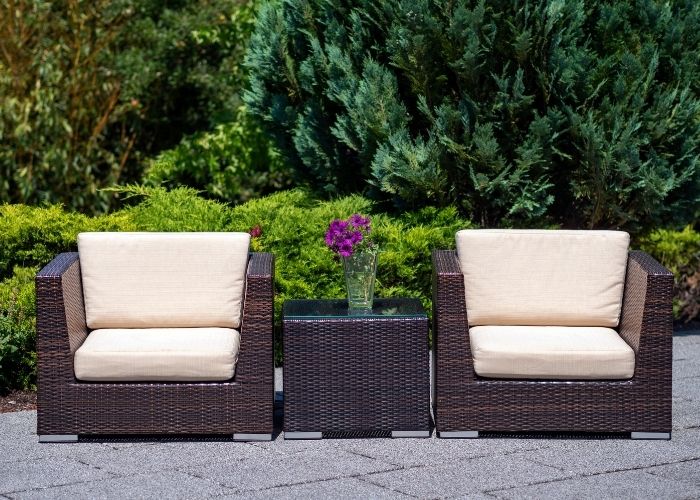
2.2 Synthetic (PE) rattan
What is PE rattan?
PE rattan is a synthetic wicker made from polyethylene strands woven over an aluminium or steel frame. It looks like natural rattan but does not absorb water.
Specify HDPE (high-density polyethylene) with UV stabilisers. Cheaper weaves made from PVC tend to become brittle and fade faster in sunlight. Ask for a UV ageing test report (a xenon-arc test such as ISO 4892-2 is common for plastics) and check weave tension, spacing and colour consistency between batches at inspection. Natural rattan is best kept under cover; it is not a material for furniture left outside all year.
2.3 Powder-coated steel
Steel is cheaper than aluminium and suits price-led ranges, but it rusts wherever the coating is chipped or scratched, often at welds and feet. If you choose steel, ask for galvanised or e-coated steel under the powder coat, and check welds and edges closely. Steel sets are also heavier for your customers to move and store over winter.
2.4 Hardwood: acacia, eucalyptus and teak
Timber gives a natural look but needs oiling, moves with the weather and brings a legal obligation. Agree the wood species, the country of harvest and a target moisture content with the factory, and inspect for cracks, open joints and mould on arrival of samples.
What is the UKTR?
The UK Timber Regulations (UKTR) prohibit placing illegally harvested timber on the UK market and require operators to carry out due diligence on species, country of harvest and supplier. They apply to many wood products, including wooden furniture; check whether your commodity code is in scope. An FSC chain of custody certificate is a useful way to support due diligence, and many retailers ask for one, but FSC is not itself a legal requirement. You can check a supplier’s certificate on the FSC certificate database. Our post on UK Timber Regulations for imported furniture covers the details.
Garden Furniture Materials Compared
| Material | UK weather performance | Main failure point | What to specify and check |
|---|---|---|---|
| Powder-coated aluminium | Does not rust; low maintenance | Coating blistering or peeling | Coating of at least 60 microns, pre-treatment method, salt spray report |
| Aluminium + HDPE rattan | Weatherproof if UV-stabilised | Fading, brittle or loose weave | HDPE (not PVC), UV ageing report, weave tension and colour match |
| Powder-coated steel | Rusts where coating is damaged | Rust at welds, edges and feet | Galvanising or e-coat under the powder, weld and edge finish |
| Acacia, eucalyptus, teak | Durable with regular oiling | Cracking, open joints, mould | Species, country of harvest, moisture content, UKTR due diligence |
Source: Easy Imex sourcing experience; QUALICOAT coating thickness requirements; UK Timber Regulations.
3) Where Garden Furniture Is Made in China
Garden furniture production is concentrated in two coastal regions. The China International Furniture Fair (CIFF) describes them as follows (CIFF, April 2026):
- Foshan, Guangdong (Shunde and Nanhai districts): the centre for design-led outdoor furniture, including ranges for hotels and contract projects. Containers usually leave through Guangzhou (Nansha) or Shenzhen.
- Zhejiang (Ningbo, Yuyao and Linhai): large-scale, highly automated production of aluminium patio sets and parasols for retail chains, at lower unit costs. Containers usually leave through Ningbo.
As a rule of thumb, start in Zhejiang for price-led retail volume and in Foshan for design, upholstery and higher-end finishes, then let samples decide. For the bigger picture of where Chinese furniture is made, see our guide to furniture manufacturing hubs in China.
Garden Furniture Clusters at a Glance
| Region | Typical strengths | Usual export port |
|---|---|---|
| Foshan (Shunde, Nanhai), Guangdong | Design-led ranges, upholstered and contract outdoor furniture | Guangzhou (Nansha) or Shenzhen |
| Ningbo, Yuyao, Linhai, Zhejiang | High-volume aluminium patio sets and parasols for retail chains | Ningbo |
Source: CIFF Click2Connect, April 2026; export ports are the nearest major container ports to each cluster.

3.1 Finding the right factory
Many garden furniture sellers on B2B platforms are trading companies. That is not always a problem, but you lose control over coating, weave and welding when the seller does not own those processes. Ask for the business licence (a factory’s scope includes manufacturing), a live video walk through the welding, coating and weaving lines, and permission for an audit. Our guides on the differences between trading companies and manufacturers and how to confirm a Chinese manufacturer is legitimate go through the checks.
Trade fairs help with shortlisting for the following season: the Canton Fair in Guangzhou runs spring and autumn sessions, and the furniture fairs in Guangzhou (March) and Shanghai (September) bring outdoor furniture makers together. Check the official Canton Fair website and our list of China trade fairs for dates. Around 70% of the products Easy Imex sources come from factories that are not listed on Alibaba, so fairs and on-the-ground visits still matter.
4) Quality Control Checks Specific to Garden Furniture
Garden furniture fails in predictable places. Put each of the checks below in your purchase order as a measurable requirement, then inspect against it. For general furniture inspection points, see our guide to furniture quality control in China.
Garden Furniture Inspection Checklist
| Component | What to check | How |
|---|---|---|
| Frame coating | Thickness, adhesion, even cover inside joints | Coating thickness gauge; cross-cut adhesion test; visual check |
| Welds and joints | Cracks, porosity, wobble under load | Visual check; load and stability test on seats and tables |
| Synthetic rattan | Material (HDPE vs PVC), tension, colour match | Material declaration; pull test; compare against the approved sample |
| Cushions | Fabric, foam, zips, stitching, fire labels | Fabric specification; colour fastness to light report (ISO 105-B02); label check |
| Fixings | Stainless or coated fixings, no rust in the box | Material declaration; visual check of packed hardware |
| Packaging | Corner protection, carton strength, hardware packs | Drop test on packed cartons; check assembly instructions |
Source: Easy Imex QC practice. Test methods: ISO 2360 (coating thickness), ISO 9227 (salt spray), ISO 105-B02 (colour fastness to light).
What is AQL?
AQL (Acceptable Quality Limit) is a statistical sampling method: the inspector checks a set number of units from the order and passes or fails the shipment against the number of defects agreed in advance.
For cushions, ask for solution-dyed acrylic or polyester fabric, which holds its colour better in sunlight, and quick-drying foam. For a first order with a new factory, book a during-production inspection as well as a pre-shipment inspection, so coating or weave problems are caught while they can still be fixed. Our guide to furniture pre-shipment inspections explains both.
5) UK Rules That Apply to Garden Furniture from China
5.1 Fire safety for cushions and upholstery
The Furniture and Furnishings (Fire) (Safety) Regulations 1988 apply to “furniture which is ordinarily intended for private use in the open air but which is also suitable for use in a dwelling” (regulation 3). In practice, upholstered garden furniture that can be brought indoors is in scope, so its fillings and covers must meet the ignitability requirements and carry the right labels. Garden furniture with no upholstery, or too large to use indoors, generally falls outside. The government has been reviewing these regulations, so check for updates before you sign off a new range. Our UKFR guide for furniture importers explains the tests and labels.

5.2 Timber legality
For wooden furniture, keep your UKTR due diligence file (species, country of harvest, supplier, risk assessment and any certificates) before the goods ship, not after they arrive. See section 2.4 and our UK Timber Regulations guide.
5.3 Safety standards and chemicals
Garden furniture sold to consumers must be safe under the General Product Safety Regulations 2005. The BS EN 581 series is the usual reference for outdoor furniture: Part 1 sets general safety requirements, Part 2 covers seating and Part 3 covers tables, with strength and durability tests. If you supply UK retailers, expect to be asked for test reports against these standards. Coated fabrics, PVC components and paints should also be checked against restricted substances under UK REACH; ask the supplier for test reports rather than a simple declaration.
5.4 Import duty and VAT
Garden seats are classified under heading 9401 (seats) and tables and other pieces under 9403 (other furniture). The exact code depends on the frame material and design, and so does the duty rate, so look up your product on the UK Trade Tariff rather than relying on a rate from an old quote. The commodity page also shows any additional duties, such as anti-dumping measures. Import VAT is charged at 20% on the customs value plus duty. Our guide to UK import duties from China and post on UK anti-dumping duties go into more detail.

6) Shipping Garden Furniture: KD Packing, Containers and Transit Times
What is KD packing?
Knock-down (KD) packing means the furniture is shipped flat or part-assembled, with legs, backs or arms removed and packed together with the fixings.
Garden furniture is bulky and light, so containers fill up by volume long before they reach their weight limit. KD packing is the single biggest lever on your freight cost per set: ask the factory for the number of sets per 40ft high-cube container in both assembled and KD formats before you agree prices, and check the assembly instructions and hardware packs during inspection. For most range orders a full container load (FCL) is the right choice; our guide to FCL vs LCL shipping explains when LCL still makes sense.
What is FCL?
FCL (Full Container Load) means you book a whole container for your goods, rather than sharing one with other shippers (LCL, Less than Container Load).
Plan on roughly four to five weeks port to port when ships use the Suez Canal, and six to seven weeks while they divert around the Cape of Good Hope, which adds about 10 to 14 days (see our supply chain disruptions guide). Add one to two weeks for UK customs clearance and delivery to your warehouse, and confirm current routings with your forwarder when you book. To work out the real cost per set, include freight, duty, VAT, port charges and inland delivery in your landed cost calculation, and see our guide to shipping by container from China to the UK.

Read Our Furniture Import Guide
How Easy Imex Helps with Garden Furniture Sourcing
Easy Imex is a UK-owned sourcing company that has been based in Shanghai since 2005, and furniture is one of our core categories (see our furniture sourcing page and home and garden page). For garden furniture we typically:
- shortlist and visit factories in Foshan and Zhejiang, including suppliers that are not on Alibaba;
- manage sampling against your specification, from coating thickness to cushion fabric;
- agree bilingual purchase contracts with measurable quality requirements;
- run during-production and AQL-based pre-shipment inspections against the checks in this guide;
- coordinate KD packing, container loading and shipping to the UK.
If you want to see factories yourself, we also organise factory visits and trade show trips. Read more about our furniture sourcing work.
Frequently Asked Questions
When do I need to order garden furniture from China for spring 2027?
For stock in the UK by early March 2027, aim to approve samples and confirm the purchase order with deposit by mid-to-late October 2026. Chinese New Year falls on 6 February 2027, production slows from mid-January, and factories take two to four weeks to return to full output after the holiday. Orders placed after October usually finish after the holiday and arrive in April or May.
Which material is best for garden furniture used in the UK?
Powder-coated aluminium, on its own or with an HDPE synthetic rattan weave, is the most common choice for UK gardens because aluminium does not rust. Powder-coated steel is cheaper but can rust where the coating chips. Hardwoods such as acacia, eucalyptus and teak need oiling and bring UK Timber Regulations due diligence.
Where is most garden furniture made in China?
The two main clusters are Foshan in Guangdong (Shunde and Nanhai districts), known for design-led and contract ranges, and the Ningbo, Yuyao and Linhai area of Zhejiang, known for high-volume aluminium patio sets and parasols for retail chains.
Do garden furniture cushions need to meet UK fire safety rules?
Often, yes. The Furniture and Furnishings (Fire) (Safety) Regulations 1988 cover furniture ordinarily intended for private use in the open air but which is also suitable for use in a dwelling. Upholstered garden furniture that can be used indoors is therefore in scope, and its fillings, covers and labels must comply.
Is FSC certification legally required for timber garden furniture?
No. The UK Timber Regulations require operators to carry out due diligence so that illegally harvested timber is not placed on the UK market. An FSC chain of custody certificate is a common and useful way to support that due diligence, and many retailers ask for it, but the law does not require FSC itself.
How long does sea freight take from China to the UK?
Roughly four to five weeks port to port when ships use the Suez Canal, and six to seven weeks when they divert around the Cape of Good Hope, which adds about 10 to 14 days. Add one to two weeks for customs clearance and delivery to your warehouse.

Next Steps
If you are planning a spring 2027 garden range, the next two weeks matter more than the next two months:
- Fix the spec: materials, coating thickness, weave, cushion fabric, fixings and packing format for each item.
- Confirm dates with the factory: production time per item, inspection date and the last container departure before the Chinese New Year slowdown.
- Check compliance early: fire safety labels for upholstered pieces, timber due diligence for wooden pieces, and the commodity code and duty for each line.
If you would like help with any of these steps, get in touch with our sourcing team.
About the Author: Adam
