


TLDR – How to Find the Right Chinese Manufacturer
Table of Contents
- The fastest way to find the right Chinese manufacturer is to follow a clear 7-step roadmap: define detailed product specs, source manufacturers (online / sourcing company / trade shows), send structured RFQs, shortlist the best suppliers, verify them, visit your top factories or have them audited, and then approve production through samples.
- Product specifications are the foundation: colours, dimensions, materials, functions, packaging, labelling, testing and compliance requirements. Even small changes in specs can have a big impact on price, feasibility and quality.
- There are three main sourcing channels: online platforms (Alibaba, Made-in-China, etc.), sourcing companies in China, and trade shows like Canton Fair. Most importers use a mix – online for research, trade shows for in-person comparison, and a sourcing partner for deeper verification and ongoing management.
- Choosing where to manufacture inside China matters: regions like the Pearl River Delta (Guangdong), Yangtze River Delta (Shanghai/Jiangsu/Zhejiang), Fujian and other clusters specialise in different categories and price/quality levels. Focusing your search on the right region for your product saves time and improves fit.
- Verification is non-negotiable: check whether suppliers are real manufacturers or traders, where the factory is located, their export experience, certifications, capacity, communication quality, interest in your business and lead times. Turning these points into a scored checklist makes comparisons much easier.
- Factory visits or third-party audits help you confirm what’s on paper: you can see production lines, equipment, workers, QC processes, warehousing and packing conditions, and judge whether they can consistently meet your standards at scale.
- Samples are your final filter before mass production: evaluate materials, dimensions, finish, functionality, labelling, packaging, compliance potential and whether the quality looks repeatable. If a factory cannot meet your spec after a few sample rounds, they’re rarely a good choice for long-term production.
- Negotiating price should balance cost and quality: use quotes from multiple factories to understand market pricing, then work towards a sustainable price structure rather than chasing the absolute lowest quote, which often leads to quality and delivery problems later.
- A sourcing agent or China-based buying office can handle sourcing channels, verification, visits, sampling, quality control and logistics on your behalf – which is often the most efficient path for SMEs and brands without their own team in Asia.
Have you ever tried to find a Chinese manufacturer for your product but been overwhelmed by the task of finding the right one?
You’ve got your dream product in mind, and your next move is to find a Chinese manufacturer. We are talking about a supportive and active manufacturer that is next to perfection in flow and organization.
We know that it is barely challenging to find a reliable manufacturer in China. If your manufacturer makes a wrong product, your customer will counter you directly, not them. You want to ensure that you find a factory that would give you the best quality at a lower price.
However, we have helped many people in the same boat make informed decisions when importing from China, incluiding importing from China to UK and we leverage our guides to do so. In this guide, we will cover everything you need to find the right Chinese manufacturer.
.
How to Find a Chinese Manufacturer for Your Product
If you are running your business and you would like to produce your products in China, but you don’t know how to find a Chinese manufacturer. Here are the steps you need to follow to find an ideal China manufacturer for your products:
Step 1. Create Your Product Specifications
If you intend to source your products in China, clear product specifications are essential. What do we mean by product specifications? Without a product specification in mind, you are likely to run into problems. Before deciding what your specs should look like, consider including the following:
- Product colours
- Product dimensions
- Packaging style
- Labelling requirements and product regulations
- Product description
- Testing specifications
- Specific materials for the product
Why do you need to define your product specs?
You can still find a manufacturer in China without detailed specifications, but the search will take longer and you risk choosing the wrong factory. Clear product specs make it easier to match with the right manufacturer and avoid misunderstandings.
Remember, you need to know your product description, labelling requirements, quality standards, materials, product variations and any compliance or certification requirements when weighing up which Chinese suppliers are a good fit.
A small difference in those product specifications can have a big impact on price.
How do you sort out your product specs?
- Start with online research on your product category. You need to understand your target sector and use that as a benchmark for the quality level you want.
- Look at competitors’ products in the same price range you are targeting. Study the materials they use and how their products are packaged.
- Read online product reviews and identify common product defects. Then design your specification to avoid those weaknesses or improve on them.
- Network with industry experts to get practical tips for defining your product specs.
- Check labelling requirements and product regulations for your target markets so your specs already align with legal requirements.
After availing yourself to sort out your product specs, consider mapping it out on a spec sheet.
It might feel like a lot of effort to create a full product spec, but it gives you a strong foundation and makes it much easier to start searching for the right Chinese manufacturer.
Once your spec sheet is ready, you can attach it to RFQs and share it with potential suppliers, sourcing agents or inspection companies so everyone is working from the same requirements.
.
Step 2. Sourcing the Right Manufacturer in China
So, you’ve got your product specifications in mind. Next move? You want to source the proper Chinese manufacturer. It is quite simple. Let’s dive into the two most straightforward ways of sourcing products from China. At this stage, your aim is not just to find any factory, but manufacturers whose capabilities, quality level and certifications match your product specifications and target volumes.

Source Manufacturers Yourself (Online)
How do you source products from China without using any external agent?
Using online supplier platforms may be the safest way to source products from China. There are four popular product sourcing platforms: Made in China, Alibaba, AliExpress, and Global sources.
Made in China platform is a top eCommerce platform in China created by Focus Technology. You can find a lot of top-notch Chinese products and suppliers’ details on this platform.
Made in China, Alibaba is also an eCommerce platform, but it is not the right choice for starters. Why is that? Manufacturers make most of the product catalogs.
AliExpress is more into retailers. However, you can still find a lot of manufacturers’ information on this platform.
In practice, many importers start by using these platforms to build an initial list of potential manufacturers, then narrow it down using filters such as product focus, years in business, certifications and export markets.
Using a Sourcing Company in China
Let me drive this point about using a sourcing company to find a Chinese manufacturer.
If you hire an invaluable sourcing agent, they will find manufacturers that you cannot.
Want to know how most of these sourcing agents work? They go the extra mile to find manufacturers that are not listed on eCommerce platforms. There are spectacular sourcing companies you could contact, such as Easy Imex, 80/20 Sourcing, and many others.
For many overseas buyers, combining online research with a trusted sourcing company like Easy Imex is the most efficient way to find factories that are a genuine long-term fit.
Find Manufacturers at Trade Shows in China
After a sourcing company, we consider trade shows fantastic for Chinese manufacturer sourcing. Trade shows are preferable because they present an opportunity to dialogue with suitable suppliers in person. They can quickly learn about your needs, how it matches their needs, and how they can work with you.
For instance, you can visit the Canton Fair in Guangzhou, The China International Furniture Expo in September in Shanghai, and many others.
Trade shows are especially useful when you want to see product quality in person, compare several manufacturers quickly, and discuss customisation or new product ideas face-to-face.
Sourcing Channels Compared (Online, Sourcing Company, Trade Shows)
Sourcing channel | How it works | Main advantages | Main drawbacks | Best for |
Online platforms (Alibaba, etc.) | Search for products and suppliers, send RFQs and compare responses | Easy to start, large choice, good for initial research | Time-consuming to verify; many trading companies; quality varies | Early research, small/medium buyers building an initial long list |
Sourcing company in China | Local team finds and verifies factories, negotiates and manages QC for you | Saves time; better verification; local language and culture support | Extra service cost; you rely on their process and transparency | SMEs, brands without a China office, ongoing or multi-SKU sourcing |
Trade shows in China | Visit fairs like Canton Fair, meet manufacturers and see samples in person | Direct contact; see quality on site; good for new ideas | Travel time and cost; limited to show dates and locations | Buyers ready to travel and build deeper relationships |
How to find the best supplier on Alibaba?
Many importers literally search “how to find the best supplier on Alibaba” – the tips below give you a simple, repeatable process you can follow each time you search.
If you have decided not to opt for trade shows and sourcing companies, you may have to stick to Alibaba to find the best Chinese supplier.
How does it work? We all know that most eCommerce platforms rely on the right keyword combinations to show search results. Alibaba is no exception.
Rather than sticking to a keyword type, you should try numerous keyword variants when searching for your product.
Say you are searching for heart rate monitors; your potential keyword combinations may include a heart rate monitor belt, chest strap fitness tracker, and chest strap heart monitor.
Key Points to focus on when searching on Alibaba:
To search for products and Chinese suppliers on Alibaba, you need to set your mind on a few essential points.
Luckily, I have those key points here!
Tip #1
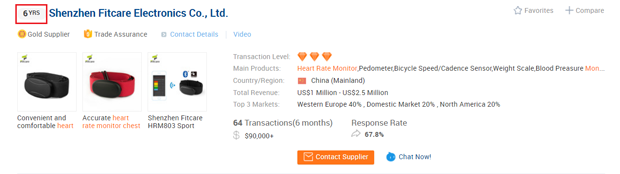
Most times, the suppliers’ level of expertise in manufacturing may be determined by the number of years they have spent in business. Hence, you should consider the suppliers’ experience when searching for Alibaba. You can easily find a Chinese manufacturer with at least three years of experience when you look for products that require a high level of expertise, such as Chest heart monitor straps.
Tip #2
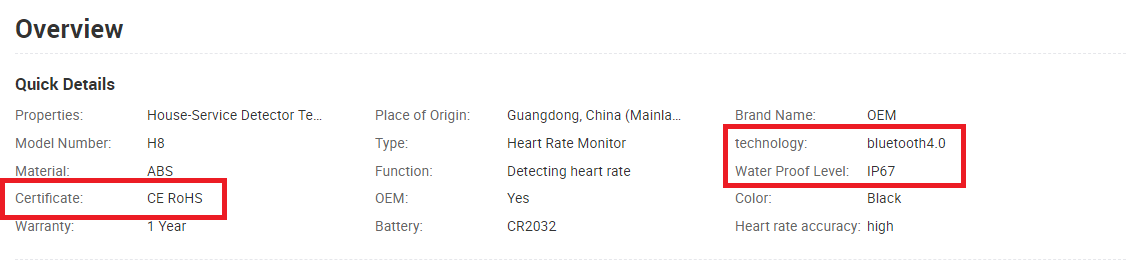
Haven’t figured out your product specs yet? It meets you here again. You need to know your product specification requirements and any compliance certificates you need for your market. This can match you to the right suppliers.
Tip #3
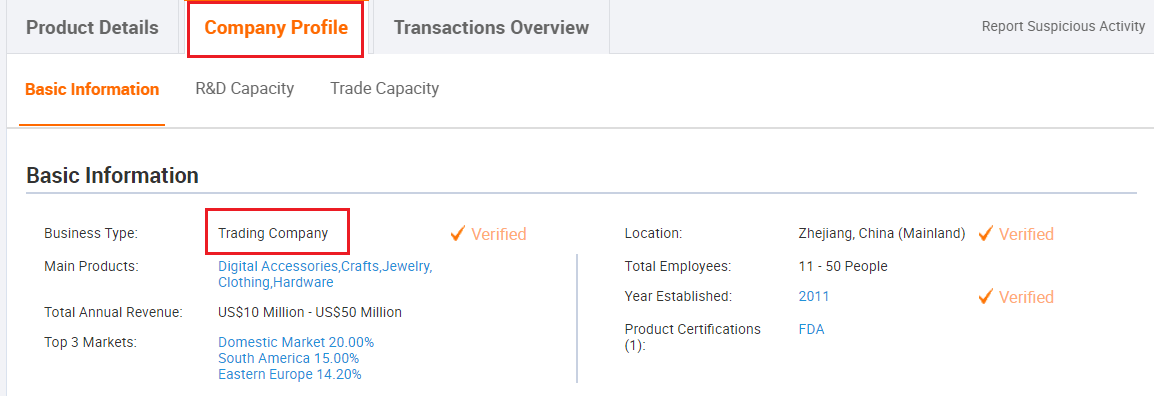
Verify your Chinese manufacturer. There are two ways you can check whether a business type is a trading company or manufacturer. First, click on the company profile tab on Alibaba and look out for the business information section. It will show whether the business type is a manufacturer or not. This method may not be reliable, especially when the supplier is a fraudster, but you still need to go through this method anyway.
Second, verify the kind of products the factory sells. After doing so, you should ask yourself the following questions: Do they sell all types of products, or do they specialize? If they specialize, then you just found yourself a Chinese manufacturer.
Tip #4
Look out for the factory location. For instance, you can’t afford to buy your products from a place where your products are merely a side hustle. For example, you don’t want to purchase electronics from a Yiwu supplier when you can try Shenzhen.
Tip #5
Try the reverse image search feature on Alibaba to find more merchandise.

Tip #6
Look out for the transaction level.
Tip #7
Check for the assessed supplier and gold supplier filter to limit your search results if it is too long.
Tip #8
Tradeshows are one of the best platforms where you would find genuine Chinese manufacturers. You get to meet manufacturers who do not even advertise themselves on Alibaba.
Tip #9
Look out for other eCommerce platforms while sourcing on Alibaba. Who knows? You may find manufacturers that are not listed on Alibaba.
By the end of this sourcing phase, your goal should be to create a shortlist of three to five serious manufacturers that match your product specs, price range and quality level.
In the next step, you’ll contact these shortlisted suppliers for quotes and start comparing them in more detail.
Step 3. Contact Chinese Suppliers for Quotes
How to structure your RFQ email
When you first contact Chinese manufacturers, your goal is to make it easy for them to understand your product, reply clearly, and show whether they are a serious, professional supplier.
It can be difficult to communicate with someone who does not speak your language well.
Formatting your email and initial request for a quote (RPQ) is essential, but communicating in a more precise language is more important. It will go a long way in increasing the chances of response on the part of the chinese suppliers. In that way, you can quickly evaluate the suppliers.
Make sure your email demonstrates professionalism and politeness, and shows that you are looking for a long-term manufacturing partner rather than a one-off order.
How do you work this out?
Avoid unclear language when emailing your suppliers. At minimum, your first RFQ email should include:
- A clear subject line (for example: “RFQ – [Product name] – [Quantity] – [Your country]”)
- A short introduction to your company and target market
- A brief product description plus your product specification sheet attached
- The quantity you are interested in for the first order and potential ongoing volume
- The Incoterms you want (for example FOB [port] or EXW)
- Any key quality or certification requirements (for example CE, UKCA, food-contact, etc.)
- Questions about their lead time, minimum order quantity (MOQ) and existing export markets
- A clear call to action, such as “Please confirm if you can produce this item and send your best quote with MOQs, lead times and product photos.”
Once you start receiving replies, you can quickly see which suppliers understand your specifications, respond professionally and are worth shortlisting for the next step.
Step 4. Creating a Shortlist of Potential China Manufacturers
How to shortlist Chinese manufacturers
At this stage, the goal is to narrow your long list of potential suppliers down to a small group of serious manufacturers that match your product specs, price range, quality level and target order volumes.
A simple way to do this is to score each supplier from 1 to 5 on key criteria such as price, product quality, communication, lead time, certifications and export experience to your target markets. This turns a vague “feeling” about each factory into a clear, repeatable comparison you can reuse on every project.
Typically, I don’t source for suppliers that exceed the range of 10-15 to avoid complexities. Afterward, I weigh my options and reduce the list to the best three to five suppliers regarding quality, price, factory location, compliance ability, etc.
I suggest you subscribe to my approach to make things easier.
Step 5. Verify Your Chinese Supplier
Supplier verification checklist
Before you commit to any factory, you need to verify whether they are a genuine manufacturer, have the right capabilities for your product, and are a good long-term fit for your business.
If you are facing the challenge of verifying Chinese suppliers, here are the key questions you should consider.
Question #1 – Does this factory match my product needs? Can they produce my ideal product? Do they have enough level of expertise and experience in my product category?
Question #2 – Are they a manufacturer or trading company?
Question #3 – Where is the factory location? How will it impact your product price? You should visit here to read more about China’s geography and see how your factory location affects your sourcing decisions.
Easy Imex staff visiting and verifying a Chinese manufacturer
Question #4 – Does the manufacturer has an effective communication system? Can you get in touch with them more often?
Question #5 – Is the Chinese manufacturer big enough to take your order volumes? Are they too small? You should consider these questions.
Question #6 – Does the firm have genuine certifications for your product? For US product regulations, visit here. For more information on EU product regulations, visit here.
Beware of manufacturers who use fake certifications.
Question #7 – What are their target selling points?
Question #8 – Do they have an export license?
Question #9 -Do they have sufficient interest in your business?
Question #10 – Is their pricing negotiable?
Question #11 – Do they have a quick turnout time?
Taken together, these questions help you understand whether a factory is capable, compliant and serious about working with you. You can turn them into a simple checklist and score each supplier from 1 to 5 on each point to quickly see who is strongest overall.
As a rule of thumb, slow or unclear communication, fake or missing certifications, no export licence, very weak interest in your project, or refusal to discuss pricing and lead times are all red flags. Clear answers, documented certifications, export experience to your target markets and proactive communication are strong green lights.
Supplier verification checklist (summary)
Verification question | What you’re checking | Red flag example |
Does this factory match my product needs? | Product focus and experience with your type of product | Very broad catalogue, no clear specialisation |
Are they a manufacturer or a trading company? | Whether they actually own/operate the factory | Vague answers, cannot clearly explain their factory role |
Where is the factory located? | Region, city, industrial cluster | Refusal to share factory address or details |
Do they have effective communication? | Responsiveness, clarity, English level | Very slow replies, inconsistent answers, misunderstand specs |
Are they big enough for your order volumes? | Capacity for your initial and future orders | MOQs too high or too low relative to claimed factory size |
Do they have genuine certifications? | Required product/quality certifications and audits | Fake or outdated certificates, unwillingness to share documents |
What are their target selling points? | How they position themselves on quality/price/service | Only “cheap price” and no mention of quality or reliability |
Do they have an export licence? | Legal ability to export | No export licence or unclear answers |
Do they have sufficient interest in your business? | Willingness to invest time in your project | Reluctant to answer questions or customise |
Is their pricing negotiable and transparent? | Openness about cost structure and terms | Large price drops with no explanation |
Do they have a reasonable lead time? | Production speed and capacity | Unrealistic promises or frequent delays in their history |
Step 6. Visit Your Top 3 Suppliers
Factory visit checklist
The purpose of visiting your top 3 suppliers is to confirm they are real manufacturers, see their production conditions with your own eyes, and decide who is genuinely the best long-term partner.
We know to visit about three factories to find the right supplier is hard work. However, it comes with tons of benefits.
By visiting the suppliers, you can quickly evaluate their strengths and weaknesses, including the quality of raw materials, factory workers, factory equipment, attitude to work, and many others.

Easy Imex staff visiting an ice cream machine factory in Guangzhou.
Virtual price negotiation is not always exactly the best choice. You can afford your visit to negotiate product prices with the suppliers and map out the one(s) that suits you best.
When you visit a factory, pay attention to:
- Production lines: Are they organised, clean and suitable for your type of product?
- Equipment: Is the machinery modern, well-maintained and sufficient for your volumes?
- Workers: Do they look trained, experienced and properly supervised?
- Quality control area: Is there a dedicated QC space and clear process for checking goods?
- Warehouse and packing: Are raw materials and finished goods stored correctly and safely?
- Communication: Does your main contact understand your requirements and respond clearly?
These are all signals of whether the factory can consistently produce to your required standard.
For existing businesses looking to source products from China, this step is essential.
After visiting your shortlisted factories, you should have a clear favourite or top two choices. The next step is to confirm your decision by getting product samples made to your exact specifications.
Step 7. Get Product Samples Made
How to manage product samples
Samples are your chance to see how closely a factory can follow your specifications, and to catch any design or quality issues before you place a full order.
At times, I don’t think the mere visit to factories is enough. You don’t need to be told that its cover cannot judge a book.
In my opinion, you should get product samples from your three best suppliers for critical evaluation.
Be meticulous with scanning through the samples.
Look out for the texture, appearance, dimension, and packaging of the product. Ask yourself. Do these qualities suit your ideal outcome?
If you are indecisive about whether to go for it, invite other people to check their samples and hear what they have to say about it.
For each sample, check:
- Materials: Are they exactly the materials you requested in your product spec?
- Dimensions and weight: Do measurements match your drawings or agreed tolerances?
- Finish and appearance: Is the colour, texture and overall finish what you expect for your brand?
- Functionality: Does the product work as intended and feel solid in use?
- Labelling and packaging: Are logos, labels, warnings and packaging aligned with your requirements?
- Compliance potential: Does the factory seem able to meet any testing or certification needed for your target markets?
I suggest you also conduct some drop tests on the packaging of the sample to confirm its sturdiness. For more information on drop tests, visit here.
Cross the manufacturer off the list of your favorites if they do not match your requirements. It is that simple.

Easy Imex QC Manager verifying furniture sample.
There is another set of additional points you need to note.
If you do not want to cross off your favorite manufacturer, you can always arrange with them and ask them to produce your ideal product sample.
In cases where you are developing a new product, I suggest arranging for product samples from a supplier on the top of your pecking order. Arranging samples from more than one manufacturer can be exhausting, especially if it is too expensive to produce.
If a factory cannot produce a sample that meets your agreed specifications after reasonable adjustments, it’s usually a sign that they are not the right manufacturer for your product. Give priority to suppliers who respond to feedback quickly and improve each round of samples.
.
Why Manufacture Your Product in China?
For many brands, the goal is not just to save money, but to access reliable capacity, established supply chains and the right level of quality for their market.
If you are curious about why manufacturing in China is a better choice, here are the quick pointers that can fuel your curiosity.
Cheaper Labour and Workforce Availability
What kind of songs does cheaper labor sing to you?
In Chinese manufacturing circles, wages are very cheap, and throwing yourself at this opportunity is as good as managing your savings.
What does this say to you? You can easily hire local Chinese manufacturers without having to break the bank when paying their wages.
The key is to combine lower labour costs with a factory that can still meet your brand’s quality and compliance standards.
Lower Manufacturing Costs
Now, you have to come around some other thing beneficial about manufacturing in China. It is their lower manufacturing costs!
The cost difference between domestic manufacturing and manufacturing in China is massive. Local manufacturers have higher training costs and higher profits.
In the same breath, China has lower training costs and higher turnovers.
By sourcing your product from china, you can tap into the opportunities that come with low manufacturing prices and higher profits. As a seller, this makes China a suitable manufacturing environment for your product!
Also, the professionalism and politeness of Chinese manufacturers make them a worthy partner!
When you calculate the full landed cost including duty, VAT and UK-side handling, China is still highly competitive for many categories, especially when you have repeat orders.
Higher Production Capacity
When it comes to bulk production, Chinese are kingpins because they produce goods worldwide. Chinese production capabilities have stood the test of time. They have durable factory equipment from a considerable number of workers, raw materials to heavy machines. When you source your products from China, consider yourself making the right decision already because you are working with factories that are capable of taking any number of order volumes.
This scale makes it easier to secure stable supply, develop new SKUs and support long-term growth once you have found the right manufacturing partner.

Better Expansion and Diversification Opportunities
Are you trying to hit it big and try covering tracks yet uncovered by your competitors? Your problem is that you need to manufacture new product lines to make this happen, but you are skeptical about the right manufacturer that can make your dream come true. Sourcing your new product line from Chinese manufacturers allow you to do this real quick.
Chinese product sourcing will offer you the additional advantages of expanding and diversifying your product lines. It can also introduce your products to the international markets!
Working with manufacturers in China also allows you to test new product lines quickly, often within the same industrial cluster or even with related factories in the same city.
Cutting Lead Times with the Right Chinese Manufacturer
When you manufacture in your own country sourcing, you are used to quick turnout time. Typically, there is no delay in the real sense of it between the start and completion time since you are manufacturing on site. It follows that you cannot produce less or more to avoid eating into an unplanned budget. However, this is often the disadvantages of manufacturing overseas. The leading time could be a long ride. Sometimes, you may have to eat into unplanned budgets. There are other problems posed by making products overseas along the line.
For Chinese manufacturers, it is different. If you are working with good Chinese manufacturers, they can find a way to cut lead times. The results are quick deliveries for your products. In many cases, it won’t eat into your budgets.
Lead times are not fixed; they depend on how well you plan, how clear your specifications are, and how strong your relationship is with the factory.
Where to Manufacture in China (By Region and City)
China is not one factory; it is a network of specialised regions and cities, each known for particular product categories and price/quality levels.
China is undoubtedly the most significant manufacturing hub globally because it deals with massive numbers of product lines. No country can stand in the space of China’s large manufacturing environment. It is because they have vast factory machinery capable of delving into mass production for a long time. In the same breath, China has many provinces.
You may not find smooth looking out for Chinese manufacturers that suit your product specs for these reasons. This is why we provide a map of China manufacturing industry and where the different sectors manufacture their products in various provinces throughout China. Different regions specialise in different products manufactured in China, so selecting the right province can cut freight times and improve quality.
In practice, you should start by identifying which region of China is strongest for your product type, then focus your supplier search on that area. This makes it more likely you will find manufacturers with the right raw materials, supporting factories and export experience for your industry.
China Manufacturing Map by Production Category

Source: Berkely group
Best Cities to Manufacture in China
So, we have shown you the map of the China Manufacturing industry. Remember, all places in the map count.
I can already figure your next rolls of questions. Is that all? What about the best places to manufacture in China?
I will address your questions shortly.
There are seven famous cities for manufacturing in China. Like I call China the largest manufacturer hub, these cities are the most significant manufacturing kingpins in China. As a result, they have the busiest ports, but it makes logistics easier anyway. If you are right there checking the map and hesitating on which Chinese city to go for your product sourcing, you should consider reading further as I present the best Chinese manufacturing cities to you.
Qingdao
Qingdao is one of China’s most massive manufacturing environments. It is laced with varieties ranging from petrochemicals, metallurgy, and many others.
The city is famous for manufacturing graphical textiles and clothes. Qingdao is located on the coast of the yellow sea.
Shenzhen
Shenzhen is famous for manufacturing electronic gadgets. It is safer to call the world’s electronics hub. Why is that?
In terms of quality raw materials for manufacturing electronics, Shenzhen is the best! Popular brands like Apple and LG make use of Shenzhen in manufacturing.
Ningbo
Unlike Shenzhen and Qingdao, Ningbo is diversified in terms of manufacturing.
What does this say?
It has various industries that range from IT, telecommunications, electronics, and many others. It is very close to Shanghai.
Tianjin
When I call China the most significant manufacturing exporter globally, I can’t complete that narrative without Tianjin. Tianjin forms part of China’s expansiveness in manufacturing as it is the largest city in northern China. It holds close to Haibe River.
More importantly, Tianjin is a master in manufacturing cell phones, automobiles, textiles, and many others in China. It is located close to Beijing.
Hong Kong
Just like Tianjin, Hong Kong is also one of the central manufacturing environments in China.
Guangzhou
Like Hong Kong and Tianjin, Guangzhou is one of China’s manufacturing kingpins. It holds close to the Pearl Delta River.
If you are looking for a city with broad diversification in terms of product sourcing, try Guangzhou. The production strength of this city ranges from tooth products to mechanic manufacturing.
Is that all you can get from Guangzhou? That’s no.
As a seller looking to expand your business’s tentacles, Guangzhou presents you with an excellent opportunity to partner with various Chinese companies.

Shanghai
In terms of trade, steel products, automobiles, medicine, petrochemical, shipping, and many others, Shanghai holds a spectacular position in China’s manufacturing order.
Why is that?
Shanghai has been experiencing rapid economic developments for many years and counting.
It remains the most popular manufacturing giant in China as it is home to popular automobile companies like Volkswagen, Dongfeng, and many others.
China manufacturing regions cheat sheet
Region / city | Main product categories | Typical positioning | Notes for buyers |
Pearl River Delta (Guangdong) | Electronics, appliances, furniture, lighting, hardware | Broad range, mid to higher quality | Very mature export base, strong supply chains and logistics |
Yangtze River Delta (Shanghai, Jiangsu, Zhejiang) | Textiles, apparel, machinery, consumer goods, packaging | Mix of mid–high quality and innovation | Good for brands needing design support and more advanced processes |
Fujian | Footwear, sportswear, bags, some furniture | Competitive pricing, strong in niches | Well known for shoes and sports brands; good for volume |
Shandong / Hebei | Heavy industry, some furniture, building materials | More industrial, often volume-focused | Can be suitable for bulky or heavy products |
Interior provinces (e.g. Henan, Hubei, Anhui) | Mixed manufacturing, components, lower-cost assembly | Often lower labour cost | Useful for price-sensitive products if QC and logistics are well managed |
How to Negotiate Price with a Chinese Manufacturer
The goal of price negotiation is not to push the factory as low as possible, but to agree a price that works for both sides and still protects quality and reliability.
There is something called the bifocals of meticulousness and knowledge when arranging product pricing with Chinese manufacturers.
Meticulousness tells you not to fall into the trap of smart Chinese manufacturers. They are always ultra careful when it comes to negotiations; you should do too. If your determinant for a lasting relationship depends on how much they can lower costs, cross it off. In some cases, you don’t need negotiation. All you need to do is build a pool of understanding between the manufacturer and you. View things from the perspective of wanting to develop a friendship.
On the other hand, knowledge tells you to come prepared. Try to research on their ideal pricing before the negotiation.
Is that all about how to arrange a price with a Chinese manufacturer? You need not be told that this is no.
Key steps for negotiating with a Chinese manufacturer:
Steps to Negotiate Price with Chinese Manufacturer:
Step 1
Do a background check. Let me drive this point about doing a background check. It is a crucial step in negotiation. I mean, there is no way you can consider yourself fit for the role of an excellent negotiator and seller without researching the Chinese factory. So, how do you work this out? Have a good knowledge of the factory location, check pricing methods, production strength, etc.
Step 2
Arrange prices with Chinese manufacturers on the top of your pecking order. You don’t have to go the extra mile to negotiate with unlisted manufacturers. You may not end up trading with them anyway because they do not meet your product specification requirements. It is nearly a useless adventure to negotiate with them. Instead, focus on your ideal manufacturer(s).
Step 3
Carve out a practical negotiation framework based on your product specs, ideal price, and many others. In short, set a standard for your negotiation. Do you want the success of your consultation to be determined by the pricing methods of the factory? Do you want only product specs to set the standard? Ask yourself these questions when carving out a strategy.
Step 4
Craft a business scenario. Keep this at the back of your mind; there is a massive influx of willing sellers with various demands and needs worldwide. Most of these Chinese manufacturers are aware of this, and you are just one of these sellers. This is why you need to craft a business side story capable of walking the factory through your specific needs. The manufacturer will have a clear idea of what you want and how you want it done through your scenario.
Step 5
Try to understand the nature of the factory. Is it an existing factory with little turnover and high minimum order requirements? Is it a new factory with high turnover, better pricing, and low minimum order requirements?
Step 6
Meet the right person(s) in the factory. In this case, I suggest you negotiate with someone who has a good measure of authority over the prices and other significant undertakings in the factory. You won’t have to juggle negotiations between bosses and subordinates. In short, it will make things easy for you. Besides, you won’t have to spend a decade at the negotiation stage.
Step 7
Look out for payment rates during negotiation. The most current standards are about thirty percent deposits, and seventy percent balance paid after bulk production or thereabout. If the payment rates are not kind to your budget, cross it off or renegotiate.
Step 8
Don’t change plans during negotiation with your Chinese manufacturer. You shouldn’t allow your budgetary policies or other standards to fall into emotional waves and side attractions.
As a general rule, avoid accepting a very low price if it is much cheaper than other quotes for the same spec – it often leads to quality shortcuts, hidden cost increases or production delays later. Focus instead on building a transparent, repeatable costing structure with the factory.
Six Reasons to Use a Sourcing Agent to Find a Chinese Manufacturer
Not every business has the time or experience to manage supplier search, factory visits, negotiation and quality control directly in China. A good sourcing agent or buying office can act as your team on the ground and remove a lot of risk from the process.
As a keen seller or business owner, you know what you want already. You know your target sectors. You know your target customers.
You have read the initial sections of this post, and it appears that product sourcing from China aligns with your business standards. But you consider a great deal of hard work to start emailing quotes, checking for leading times, and many other things. Remember, we are here to help you scale up your business, and here’s why we are providing three reasons you should use a sourcing agent to find your ideal Chinese manufacturer.

Import Direct vs Sourcing Agent vs Professional Sourcing Company
You can read this article about how to find the best sourcing agent in China.
Trustworthy Suppliers and Better Pricing
A sourcing agent is your best bet for a seller or business owner who is crazy about quality relationships with suppliers and fair pricing. Active and productive suppliers are the key to a flourishing importing business.
Why is that?
It is because suppliers are the ones responsible for the mass production of products that will spur demand from customers. If your suppliers screw up, you also end up in trouble.
So, if you want the right supplier, make use of a sourcing company. A sourcing company will serve as an intermediary between you and a reliable supplier.
In this case, how do sourcing agent works? Sourcing agents will go in your place to visit top Chinese manufacturers, check the production strength of the factory, order their samples, and see if they match your needs or standards. Your standards could be your product specs, pricing methods, and many others.
The good thing about sourcing agents is that they have a sharp eye for the best suppliers. They also know where to find them easily.
In short, a sourcing agent will do all the legwork for you and even go the extra mile by securing better China manufacturing costs. It is because they have substantial connections with Chinese manufacturers.
You have seen one reason why using a sourcing agent is a better choice, tap into it!
How China Sourcing Companies Solve Communication and Culture Issues
Language and culture pose a problem everywhere. It often raises even more significant issues between a foreign trader and a Chinese manufacturer. There is usually a subtle gap between the client and the manufacturer, especially when the previous emails quote to the latter.
What does this mean to you?
As a business owner, you have to learn the art of using understandable languages for your manufacturer. You must identify accurate product specs and leave no walls of confusion or even misinterpretation on the supplier. Remember where there is wrong communication, there will be a clash of expectations.
However, if you hire a sourcing agent for such a task, you may not have to worry about wrong translations and clashed expectations. Sourcing companies have the expertise and experience to deal with culture and communication issues.
Sourcing agents are your ambassador (literally) and could be the center of your China manufacturing adventures. Sourcing agents can speak many languages, plus they are usually culturally intelligent too.
If you want a foretaste of good sourcing agents in China, I suggest you go for Dragon, Ejet, Imex, and many others. These sourcing companies have been in the sourcing system for a long time. So, they are a good catch provided you are willing to try them out.
I know that not all these good sourcing companies can be as perfect as you want them, but they could solve clashed culture and communication issues at least.
How a Chinese Sourcing Companies Reduces Business Risk.
I know that the decision to source products from China can be a difficult one.
You don’t want to be a victim of business scams.
Perhaps, you want your outsourcing to marry success. Success in outsourcing may pose a challenge because you are new to China. If you try hiring a sourcing agent, you don’t have to build the walls of anxiety around you concerning your outsourcing.
Sourcing companies comprise trained experts who know their onions. They can help supervise production volume, reduce the prospects of delays in figuring the right Chinese manufacturers, prevent you from getting cheated, and control the products’ quality. These companies can also monitor the status of your order.
With sourcing companies, you don’t have to bother about the submission of accurate product specs. Once you know your product specs, you are covered.
They can ensure that you get your products from the manufacturer on time and even minimize overheads.
In situations where the manufacturers are manipulative, sourcing agents can be of great help in that context. It is because they have a way of communicating effectively with Chinese manufacturers than foreign business owners.
Sourcing agents are not only better informed about the non-legal aspects of China manufacturing but also the legal aspects. They are aware of existing regulations and compliance procedures regarding product lines. Hence, they ensure that appropriate licenses and certifications are obtained.
From outsourcing genuine Chinese manufacturers to inspection roles, sourcing companies are always quick to identify potential business risks. It follows that they can prevent these risks. When it graduates from risks to real issues, they can handle everything.
A sourcing company reduces business risks with a higher sense of transparency, diligence, professionalism, and politeness.
So what are you waiting for? Do not let the opportunities that sourcing companies present to you slip away? If you are a foreign trader looking to source products from China, try hiring sourcing agents, and you will see its beauty.
Ongoing Monitoring of the Production Process
Once a sourcing agent has chosen the factory to manufacture your products, and you’re happy with the initial samples, the production process can begin.
However, there is no guarantee that the factory will continue to provide products that meet the same high-quality standards as the approved product samples.
Unfortunately, it’s not uncommon for quality standards to slip. The resulting products can vary in terms of quality.
Promised delivery times are often not met. There can be all manner of reasons given for production delays. Machines break down, workers are absent, or production is unexpectedly problematic. There will be no way of checking whether you are getting the truth or not.
A good sourcing agent will help you to avoid these problems.
Initially, the sourcing agent plans production, materials, personnel, and equipment with the factory.
The sourcing agent ensures that production runs smoothly and in keeping with the quotation for the work.
A good sourcing agent observes any lapses in quality and ensures the elimination of inconsistencies. The mass-produced products must meet the same quality standards as the initial samples.

It may be that the agent outsources quality control to a third party, a trusted representative, who will also monitor the factory’s in-house quality control team to ensure high standards are constant. A third-party quality control specialist enables another layer of security in the production process.
Refinement of Existing Processes
The observant sourcing agent always looks for ways to improve systems. Does the production process utilize new and innovative production methods? Then it can be easy to spot how to improve the process.
Even with long-term tried and tested production methods, the sourcing agent is always looking for ways to make processes more efficient.
A responsible sourcing agent passes on improved costs to the client, resulting in a faster and more economical production process in the future. In this way, the agent wins more loyalty from the client, and the factory can operate more efficiently. All parties benefit from a sourcing agent’s constructive approach to process refinement.
Factory Auditing and Compliance Checks
An audit is essential to determine the realities of factory production. Auditing will ensure that the company can manufacture products to a high standard. A factory audit minimizes risk and increases the likelihood of a successful, trouble-free production process.
A factory audit begins with a full investigation of the supplier, the production methods, research and development, and the supply chain.
The audit progresses with an in-depth evaluation of the company’s capabilities and reliability, resulting in an ISO9000 factory rating.
The factory audit addresses these subjects:
- Information, legality, and credit-worthiness
- Human resources (team structure and employee numbers)
- Capacity for trading and production
- R & D (sampling and equipment testing)
- Quality control (system, relevant certificates, complaints process)
A factory audit ensures the legitimacy of a manufacturer. It will enable you to determine that the factory can fulfill instructions and meet demand. That means you can have confidence that your order will be satisfactorily met and completed on time.
Using a sourcing company makes the most sense if you are based outside China, do not have an in-house team in Asia, and plan to place regular orders or develop multiple product lines. In those situations, the extra margin paid to a sourcing partner is often outweighed by better prices, fewer problems and saved time.
Conclusion: Choosing the Right Chinese Manufacturer
This guide has walked you through all you need to know to find the right Chinese manufacturer for your product but if you need a few reminders, read below:
- Do not underestimate the power of having product specs in mind. It is more like your business ruler. You need it to meet an ideal Chinese manufacturer.
- Sourcing agents are for perfect for your sourcing tasks. You should hire them if you don’t like legwork.
- Ensure you have a good negotiation strategy in mind. Do not allow your Chinese manufacturer to catch you unawares, perhaps if you are not employing a sourcing agent’s services.
- Network with those who are ahead of you in the industry. They are one of your best bets for sourcing tips.
- Go to trade fairs often. Your ideal Chinese manufacturer may be waiting right there for you.
- Have an excellent budgetary plan in place. Do not go overboard with your budget.
- Research on your ideal Chinese manufacturer.
- Understand your ideal Chinese supplier.
- Research on best places for manufacturing in China.
Overall, if you have read this complete guide about how to find the right Chinese manufacturer, you should have a clear idea of the path you need to take forward. However, if you need the help of a professional sourcing company; At Easy Imex we would be excited to guide you through the entire process. We would handle the sourcing process and make sure we select the best Chinese manufacturer for your product, carry out negotiation with factories, payment options, sampling, quality control and shipping.
Over time, your goal is to build a shortlist of trusted manufacturers who understand your products, your quality standards and your markets, so each new project becomes faster and less risky than the last.
If you prefer to have a team on the ground in China, Easy Imex can handle sourcing, factory verification, sampling, quality control and shipping on your behalf, so you can focus on product development and sales.
Get in Touch Now!
Need professional help to import from China? Tell us your needs in the form below and our professionals will get back to you within 24 hrs.
FAQ – Finding the Right Chinese Manufacturer (Updated)
- I want to find a Chinese manufacturer for my product – what’s the step-by-step process?
Start by creating a detailed product specification (materials, dimensions, functions, packaging, labelling, compliance). Then use sourcing channels such as online platforms (Alibaba, Made-in-China), trade shows and/or a sourcing company in China to build an initial list of suppliers. Send structured RFQs to the most relevant factories, shortlist three to five based on responses, and verify them using clear questions about capabilities, certifications and export experience. Next, visit your top factories or have them audited, then order samples from your favourites and evaluate them carefully before committing to mass production. - Is it better to use Alibaba, a sourcing company or trade shows to find manufacturers in China?
Each channel has different strengths. Online platforms are easy to access and good for building a long list quickly, but require more work to verify suppliers. Trade shows give you face-to-face contact and a chance to see quality in person, but require travel. A sourcing company in China can do the heavy lifting locally – searching, shortlisting, investigating and negotiating – but charges a service fee. Many buyers use all three: online research for ideas, trade shows for deeper comparison, and a sourcing company to manage verification and production long-term. - How do I decide which region or city in China is best for my product?
China is made up of specialised manufacturing regions. For example, the Pearl River Delta (Guangdong) is strong in electronics, appliances, furniture and lighting; the Yangtze River Delta (Shanghai/Jiangsu/Zhejiang) has a wide range of consumer goods, textiles and more advanced processes; Fujian is known for footwear and sportswear; other regions focus on heavy industry, components or lower-cost assembly. Start by identifying where your product category is usually made, then concentrate your search on that region – this increases your chances of finding factories with the right supply chain, experience and quality level. - What should I include in my first RFQ email to Chinese manufacturers?
Your first RFQ should clearly explain who you are, what you need and what you want from the supplier. Include a straightforward subject line, a brief introduction to your business and target market, your product spec sheet (with drawings or photos if applicable), expected order quantities, preferred Incoterms (e.g. FOB port), any mandatory certifications (e.g. CE, UKCA, FDA), and questions about MOQ, lead time and export markets. Ask them to confirm if they can make the product and to send a detailed quote, including pricing, MOQs, lead times and product photos. - How can I systematically verify a Chinese manufacturer before I place an order?
Use a structured checklist. Ask whether they are a manufacturer or trading company, where the factory is located, what products they specialise in, and which markets they export to. Check whether they have the right certifications and an export licence, whether their capacity matches your volume, how quickly and clearly they communicate, and how they handle quality control and defects. You can score each supplier from 1 to 5 on these points to compare them objectively and remove those that show consistent red flags. - Do I really need to visit the factory in China, or is a third-party audit enough?
A visit is ideal when your volumes justify it, because you can see production lines, equipment, workers, QC processes and storage with your own eyes. However, if you cannot travel, a third-party factory audit by a sourcing company or inspection agency in China is a strong alternative. The key is that someone you trust inspects the factory in person and reports back on capabilities, compliance and real-world operating conditions before you commit to big orders. - How should I evaluate product samples from Chinese manufacturers?
Treat samples as a mini quality audit. Check whether materials match your spec, verify dimensions and weight, assess colour and finish, and test how the product functions in real-world use. Review labelling, logos, warnings, barcodes, inserts and packaging, and consider whether the product looks ready for any necessary certifications or lab tests. Ask the factory to adjust based on your feedback; factories that respond quickly and improve with each round are usually better long-term partners than those that ignore or resist feedback. - What’s the best way to negotiate price with a Chinese manufacturer without damaging quality?
Start by collecting quotes from multiple factories so you understand a realistic price range for your spec. Discuss the cost drivers (materials, packaging, order quantity, optional features) and aim for a price that works for both sides rather than pushing to the lowest possible number. You can negotiate by adjusting quantities, simplifying specs slightly, planning repeat orders or offering faster decisions – not by asking for the same spec at half the market price. Very low quotes often signal hidden compromises on materials, workmanship or delivery reliability. - Should I find and manage Chinese manufacturers myself or use a sourcing agent?
Doing everything yourself offers full control and can work if you have time, experience, language skills and the ability to visit China or manage audits. Using a sourcing agent or buying office in China reduces risk and workload: they can search and vet factories, negotiate, oversee samples, carry out quality control and coordinate shipping. For SMEs, new importers and brands wanting to launch multiple SKUs without building their own China team, a sourcing company is often the most efficient option. - What are the most common mistakes companies make when choosing a Chinese manufacturer?
Typical mistakes include: starting without clear product specifications, focusing only on the lowest price, not checking whether a supplier is a real manufacturer, skipping factory verification or visits, relying on a single sample before a large order, ignoring quality control until problems appear, and choosing factories in the wrong region for their product category. Following a structured 7-step process – specs, sourcing, RFQs, shortlisting, verification, visits/audits and sample validation – greatly reduces the risk of picking the wrong manufacturing partner.
About the Author: Adam

- TLDR – How to Find the Right Chinese Manufacturer
- How to Find a Chinese Manufacturer for Your Product
- Why Manufacture Your Product in China?
- Where to Manufacture in China (By Region and City)
- How to Negotiate Price with a Chinese Manufacturer
- Six Reasons to Use a Sourcing Agent to Find a Chinese Manufacturer
- Conclusion: Choosing the Right Chinese Manufacturer
- Get in Touch Now!
- FAQ – Finding the Right Chinese Manufacturer (Updated)
- About the Author: Adam
- 17 Comments
- Leave A Comment Cancel reply
Very helpful guide! I now have better insights on how to find the right manufacturer for my product. Thank you!
Why can “anything” be made in China?
The Chinese government started to open up the country by making it easier for foreign companies to manufacture their products. It also helps that they have a low currency value, with cheap and disciplined work, and almost non-existent copyright and environmental laws.
Is everything from China fake or of poor quality?
China has had a bad reputation for a long time regarding its products. This is because in the 1980s and 1990s China had neither the production capacities nor the technology of the West.
Nowadays, a great amount of top companies manufacture many of their best products in China. Even many leading companies in Germany, Japan, the UK and the US, among others, reduce costs by increasing quality by manufacturing in China. For example, Apple, the major technology companies, has suppliers in China, and today’s fastest growing international technology company, Huawei, is Chinese.
Best piece of advice when importing from China
Although there is not just one exclusive advice that you should take into account when importing from China, from Easy Imex we recommend you to always make sure that the supplier is reliable and has the necessary permits for the import of products.
And how can you do this? You can check reviews of this company, news or blogs in which the company is mentioned or take a look at their website
How can I find Chinese furniture suppliers?
A very good way to do this is through furniture fairs. There you will find a large number of different suppliers where you can see their products in situ and negotiate. However, there is a downside: you don’t get to see the manufacturing process, quality controls, etc. Factors that make a supplier a quality supplier, no matter how good a stand they have. In Easy Imex we have several reliable suppliers that we not only corroborate their quality every time we go to work with them, but also depending on what each client demands we customise the supplier according to what they need.
Furthermore, the airspace in China is closed and inaccessible by COVID for foreign companies who want to attend trade fairs. The best way nowadays is to cooperate with a sourcing agent like Easy Imex. They have a physical presence in China and can travel to the factories at any given time.
What budget is required to import from China?
Establishing an average budget would be complicated, as everything will depend on the product you want to import, the volume as well as the supplier you choose. You will therefore need to consider all these variables before setting a budget. However, to make the process easier for you, Easy Imex can help you to solve all your doubts and provide you with a tailor-made quotation for your particular case. Do not hesitate to contact us!
What are the pros when it comes to import furniture from China?
When it comes to import furniture from China, there are three main pros that should be taken into account: good prices in most cases, full control of the import process and access to your manufacturers, working directly with them.
What are the best places to manufacture from China?
There are several cities in China, which are great to manufacture from, these are:
Hong Kong: Hong Kong is one of China’s most important manufacturing environments.
Guangzhou: If you are looking for a city with a wide diversification in terms of product sourcing, try Guangzhou.
Ningbo: It has various industries ranging from IT, telecommunications, electronics and many others. It is close to Shanghai.
Tianjin: Tianjin is a master manufacturer of mobile phones, automobiles, textiles and many others in China. It is located near Beijing.
Qingdao: The city is famous for the manufacture of textiles and graphic clothing.
Shenzhen: In terms of quality raw materials for the manufacture of electronic products, Shenzhen is the best
Why should I contact a sourcing agent to find a Chinese manufacturer instead of doing it on my own?
The main reason why you should contact a sourcing agent when it comes to find a Chinese manufacturer are:
Sourcing agents from China can solve communication and cultural problems.
Chinese sourcing agents reduce business risk.
Helps you to find reliable Chinese suppliers and the best prices in China
Ensures continuous control of the production process.