
TL;DR
- China vs Vietnam sourcing is a strategic decision that depends on product category, order volume, and total landed cost — not labor savings alone.
- Vietnam has lower manufacturing wages, but total landed cost savings are frequently smaller than expected once freight, QC, and inventory carrying costs are included.
- China dominates complex, high-volume, and technically sophisticated manufacturing through unmatched industrial clustering in cities like Foshan, Dongguan, and Yiwu.
- Vietnam is genuinely competitive for textiles, footwear, and simple labor-intensive assembly — categories where it has built real export manufacturing capability over 20+ years.
- US Section 301 tariffs on Chinese goods create a cost incentive to source from Vietnam, but Vietnam carries its own 20% US reciprocal tariff — once that is included, the net tariff advantage is real but often much smaller than headline Section 301 rates suggest. Buyers must run the full landed-cost math, not just compare tariff percentages, and screen for origin washing.
- China’s QC and supplier vetting infrastructure (Alibaba, Canton Fair, nationwide inspection agencies) is vastly more developed than Vietnam’s, making supplier discovery and quality management harder in Vietnam.
- A dual-country China Plus One strategy can reduce tariff and supply chain risk, but adds management complexity and works best only when order volumes justify meaningful relationships in both countries.
Introduction
China vs Vietnam sourcing is a strategic manufacturing decision that compares China’s unmatched industrial scale, ecosystem depth, and supplier infrastructure against Vietnam’s lower labor costs and reduced US tariff exposure — with the optimal choice depending on product category, order volume, quality requirements, and total landed cost rather than labor savings alone.
If you’re an importer facing tariff pressure and being told to “just move to Vietnam,” this guide is for you. The reality is more nuanced than any headline suggests. Some products genuinely belong in Vietnam. Others should stay in China. And for many buyers, the right answer is a carefully structured dual-country approach — not a wholesale switch.
At Easy Imex, we source from China for clients every day. This guide delivers our honest, product-by-product, cost-complete assessment of both countries — covering QC infrastructure, supplier vetting, origin washing risk, and total landed cost in a level of operational detail that no trade media outlet or law firm can match.
1) Why the China vs Vietnam Sourcing Question Has Changed in 2025-2026
The China vs Vietnam sourcing question has fundamentally shifted since 2018. US-China trade tensions, escalating tariffs, and accelerated supply chain diversification have turned what was once a niche consideration into a mainstream strategic decision for importers of all sizes. But the answer is still not simple.
1.1) The Impact of US-China Tariffs on Sourcing Decisions
US tariffs on Chinese goods — now reaching 25% or higher on a broad range of product categories under Section 301 and further escalated under Trump administration actions in 2025-2026 — have made Vietnam’s lower tariff exposure a meaningful cost factor for importers. For many HS code categories, Vietnam’s Most Favored Nation (MFN) tariff rates are significantly lower than the tariff-inclusive cost of equivalent Chinese goods.
However, this advantage only materialises when Vietnam is the genuine country of manufacture. Buyers who do not screen for origin washing risk are exposed to both customs enforcement penalties and quality failures. We cover this in detail in Section 4.
1.2) What “China Plus One” Actually Means for Buyers
The China Plus One strategy is a supply chain diversification approach where brands maintain their primary manufacturing in China while establishing a secondary sourcing country — typically Vietnam, India, or Mexico — to reduce geopolitical risk and tariff exposure, rather than replacing China entirely.
This is a critical distinction. Most brands running a China Plus One strategy still source the majority of their volume from China. Vietnam is a complement, not a replacement — at least for any product with meaningful technical complexity.
1.3) Why This Is Not a Simple “Cheaper = Better” Calculation
Total landed cost is the complete cost of a manufactured product from factory floor to destination warehouse, including unit price, freight, import duties, insurance, quality control, rework, and inventory carrying costs — and is the correct basis for comparing China vs Vietnam sourcing, not labor cost alone.
Every section of this guide is built around that principle. Where Vietnam saves on labor, it often costs more on freight, QC access, development time, and supplier management overhead. The math must be done in full before a sourcing decision is made.
Read the Step-by-Step Import Guide
2) Labor Costs: China vs Vietnam Manufacturing in 2026
Vietnam’s manufacturing wages are lower than China’s, but the true cost difference per finished unit is often smaller than labor cost comparisons suggest — because productivity, training, lead times, and total employment costs narrow the gap considerably.
2.1) Current Manufacturing Wages: China vs Vietnam
Manufacturing wages in both countries have risen significantly over the past decade. China’s wage growth reflects both rising living standards and deliberate government policy to move up the value chain. Vietnam’s wages have risen rapidly as its manufacturing base has expanded, though they remain lower than China’s in most sectors.
Manufacturing Labor Cost Comparison — China vs Vietnam (2025-2026)
| Country | Avg. Monthly Manufacturing Wage (USD) | YoY Trend | Notes |
|---|---|---|---|
| China | ~USD 700–950 (varies by region and sector) | Gradually rising | Higher in coastal manufacturing hubs (Guangdong, Zhejiang); lower in inland provinces |
| Vietnam | ~USD 250–350 (varies by sector) | Rising faster in percentage terms | Higher in Ho Chi Minh City and Hanoi industrial zones; lower in secondary zones |
Source: ILO Global Wage Report and World Bank country data, 2024-2025. Figures are indicative ranges — verify current rates before making sourcing decisions.
2.2) Why Labor Cost Savings Are Often Smaller Than Expected
The wage gap between China and Vietnam is real, but several factors reduce the per-unit saving in practice:
- Productivity differential: Chinese factory workers in established manufacturing clusters have decades of accumulated experience. Vietnamese factories — particularly for complex products — often require longer production runs to achieve comparable output per worker.
- Training overhead: For technically demanding products, Vietnamese factories carry higher training and supervision costs that partially offset wage savings.
- Total employment cost: Social insurance, benefits, and statutory contributions add to the base wage in both countries. The net gap is smaller than gross wages suggest.
- Wage growth trajectory: Vietnam’s wages are rising faster in percentage terms than China’s as its manufacturing base matures — the arbitrage window is narrowing.
2.3) Productivity and Specialization: The Hidden Cost Factor
Industrial clustering is China’s structural manufacturing advantage whereby entire supply chains — raw materials, components, tooling, finished goods, and specialist labor — concentrate geographically in specific regions such as Foshan for furniture, Dongguan for electronics, and Yiwu for small commodities, enabling cost and speed efficiencies that Vietnam has not yet replicated at scale.
A furniture factory worker in Foshan may have spent 15 years working on a specific joint technique. Vietnam’s younger manufacturing workforce, while skilled in labor-intensive tasks, has not yet accumulated equivalent category-specific expertise for complex goods. This difference is invisible in a wage comparison but shows up directly in per-unit cost and defect rates.

In our experience managing sourcing projects from both China and Vietnam, the single biggest surprise for clients is how quickly the labor saving on paper disappears once you account for longer sampling cycles, higher rework rates, and the cost of getting a QC inspector to a secondary Vietnamese industrial zone. The headline wage gap is real — but the landed cost gap is often far smaller.
3) China vs Vietnam Manufacturing: What Each Country Does Best
China dominates complex, high-volume, and technically sophisticated manufacturing through unmatched industrial clustering. Vietnam is genuinely competitive in labor-intensive categories like textiles, footwear, and simple assembly — but lacks the supply chain depth for most technical products.
3.1) Product Category Recommendation Matrix
No other sourcing guide in the SERP provides this level of category-specific guidance. Use this matrix as a starting framework — individual supplier capabilities vary and a category-specific assessment is always recommended before committing.
China vs Vietnam Sourcing — Product Category Recommendation Matrix (2026)
| Product Category | Better Sourced From | Primary Reason | Key Consideration |
|---|---|---|---|
| Furniture / Home Goods | China (Foshan) | Deep ecosystem: timber, hardware, finishes, tooling all co-located | Vietnam can compete on simple upholstered pieces; complex joinery stays in China |
| Textiles / Apparel | Vietnam | 20+ years of export manufacturing capability; strong FTA access | Fabric inputs often still sourced from China — verify local content for origin compliance |
| Footwear | Vietnam | Major global brands have established production base here | Technical footwear and injection-molded components still favor China |
| Electronics / Components | China (Dongguan, Shenzhen) | Component supply chain, PCB manufacturing, and tech ecosystem unmatched | Vietnam has some assembly operations but lacks component manufacturing depth |
| Plastics / Injection Molding | China | Tooling, mold-making, and plastics ecosystem vastly superior | Vietnam typically imports molds from China anyway |
| Metalwork / Hardware | China | Steel, aluminum, and metal fabrication clusters (Foshan, Dongguan) | Vietnam has some capacity but limited for precision metalwork |
| Simple Assembly | Vietnam (competitive) | Labor-intensive, low-complexity assembly benefits from lower wages | Ensure components are genuinely sourced in Vietnam for tariff compliance |
| Tooling / Molds | China | China is the global tooling capital — no equivalent in Vietnam | Even factories producing in Vietnam typically commission tooling from China |
Source: Easy Imex analysis based on supplier sourcing operations, 2026. Individual supplier capabilities vary — request a category-specific assessment from Easy Imex before making a sourcing decision.

3.2) China’s Industrial Clustering Advantage
China’s manufacturing advantage is not just about scale — it is about co-location of the entire supply chain. In the major furniture manufacturing hubs in China, you can find timber merchants, hardware suppliers, upholstery specialists, lacquer applicators, QC agencies, and freight forwarders within a 30-minute drive of each other.
- Foshan (Guangdong): Furniture, ceramics, and home goods — the world’s largest furniture manufacturing cluster
- Dongguan (Guangdong): Electronics assembly, hardware, and precision manufacturing
- Yiwu (Zhejiang): Small commodities, gifts, toys, and general merchandise
- Shenzhen (Guangdong): Consumer electronics, PCB manufacturing, tech components
Vietnam’s manufacturing is concentrated in industrial zones along the Hanoi/Haiphong corridor in the north and around Ho Chi Minh City in the south. These zones are productive but do not replicate the supply chain depth of China’s clusters — raw materials, components, and tooling are frequently imported from China.
3.3) Where Vietnam Genuinely Wins: Textiles, Footwear, and Simple Assembly
Vietnam has built genuine, world-class manufacturing capability in several categories over more than two decades of export-oriented production:
- Apparel and garments: Global fashion brands including Nike, Adidas, and H&M produce significant volumes in Vietnam
- Footwear: Vietnam is one of the world’s top three footwear exporters by volume
- Simple textile goods: Bags, basic home textiles, and soft goods where labor intensity is high and technical complexity is low
- Basic assembly operations: Products requiring significant hand labor with simple components
3.4) Tooling, Molds, and Complex Manufacturing: Why China Still Leads
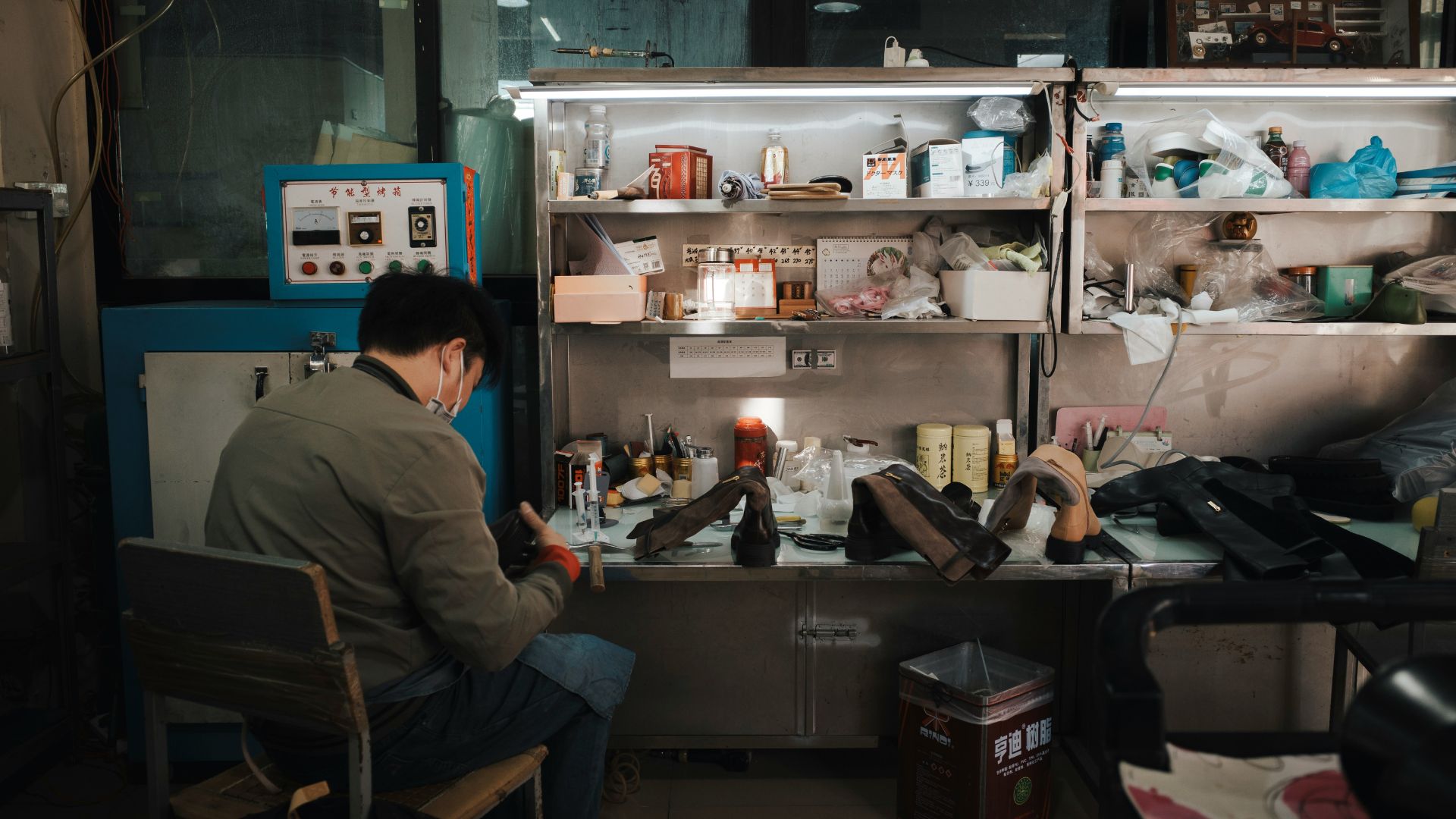
Vietnam’s manufacturing base lacks deep tooling and mold-making infrastructure. For any product requiring custom dies, injection molds, or precision tooling, China’s ecosystem is the practical choice — and Vietnam factories often acknowledge this by sourcing their own tooling from Chinese suppliers.
When clients ask us about tooling for custom products in Vietnam, our consistent finding is that the tooling is being made in China and shipped to Vietnam for production — which adds lead time, increases development cost, and partially defeats the purpose of moving sourcing to Vietnam in the first place.
4) Tariffs and Trade Costs in 2026: The Real Numbers
US tariffs on Chinese goods are significantly higher than Vietnam’s for most product categories, creating a real cost incentive to source from Vietnam — but origin washing (Chinese goods falsely labeled as Vietnamese) is a growing compliance and quality risk that buyers must actively screen for before committing to a Vietnamese supplier.
4.1) US Tariff Rates: China vs Vietnam by Product Category
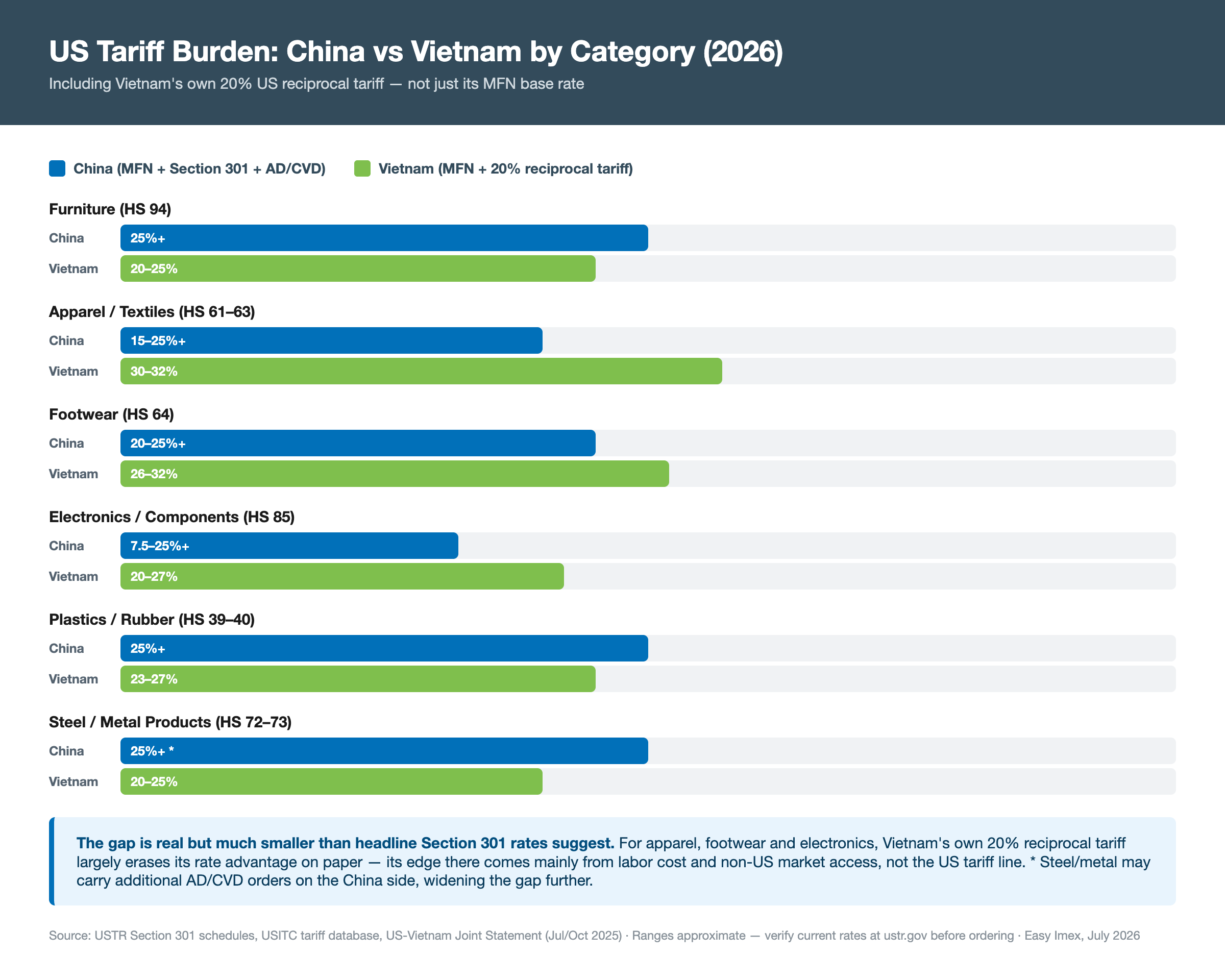
Section 301 tariffs imposed on Chinese goods from 2018 onwards — and further escalated under the Trump administration in 2025-2026 — have created a significant tariff differential between China and Vietnam for many product categories. The table below reflects the general tariff landscape as of 2025-2026, but rates are subject to change. Always verify current rates at USTR.gov before making sourcing decisions.
US Tariff Rates — China vs Vietnam by Product Category (2025-2026)
Vietnam is not tariff-free (updated July 2026): Under the July 2025 US-Vietnam trade framework, Vietnam carries its own 20% US reciprocal tariff on most goods, reaffirmed in follow-up negotiations through early 2026. The table below adds this on top of Vietnam’s MFN base rate — comparing it only to China’s Section 301 rate, as some sources do, significantly overstates Vietnam’s tariff advantage.
Separately, a temporary 10% Section 122 surcharge applies to imports from most countries (including both China and Vietnam) as of early 2026. It is under active legal challenge and set to expire July 24, 2026, so it is excluded from the table below — see our full US tariff guide for details.
| HS Code Category | China Tariff Rate (approx.) | Vietnam Tariff Rate (approx.) | Net Saving (Vietnam) | Origin Washing Risk |
|---|---|---|---|---|
| Furniture (HS 94) | 25%+ (Section 301) | 20–25% (0–5% MFN + 20% reciprocal) | Modest — narrows sharply once Vietnam’s own tariff is counted | High |
| Apparel / Textiles (HS 61–63) | 15–25%+ | 30–32% (10–12% MFN + 20% reciprocal) | None on US tariffs alone — Vietnam’s edge here comes from labor cost and FTA access to non-US markets, not the US tariff rate | Medium |
| Footwear (HS 64) | 20–25%+ | 26–32% (6–12% MFN + 20% reciprocal) | None on US tariffs alone — same caveat as apparel | Medium |
| Electronics / Components (HS 85) | 7.5–25%+ | 20–27% (0–7% MFN + 20% reciprocal) | Minimal to none, depending where in the China range you land | High |
| Plastics / Rubber (HS 39–40) | 25%+ | 23–27% (3–7% MFN + 20% reciprocal) | Minimal | High |
| Steel / Metal Products (HS 72–73) | 25%+ (plus AD/CVD in some cases) | 20–25% (0–5% MFN + 20% reciprocal) | Modest, larger if China AD/CVD applies | Medium–High |
Sources: USTR.gov Section 301 tariff schedules, USITC tariff database, and the US-Vietnam Joint Statement on reciprocal trade (July 2025 / October 2025). Rates verified as of July 2026 and exclude the contested Section 122 surcharge (see note above). Tariff policy is changing rapidly in 2026 — verify current rates at USTR.gov before making sourcing decisions.
4.2) Vietnam’s Free Trade Agreements and Who Actually Benefits
Vietnam is a signatory to several significant trade agreements that provide preferential market access:
- CPTPP (Comprehensive and Progressive Agreement for Trans-Pacific Partnership): Provides preferential tariff access for Vietnam exports to Canada, Australia, Japan, New Zealand, and other member states
- EVFTA (EU-Vietnam Free Trade Agreement): Reduces tariffs on Vietnamese goods entering the EU — a significant benefit for European importers
- ASEAN Free Trade Agreements: Preferential access across Southeast Asian markets
US-based importers do not benefit directly from CPTPP or EVFTA. Their primary benefit from Vietnam sourcing is avoiding Section 301 and related US tariffs on Chinese goods — and that benefit is only real if Vietnam is the genuine country of origin.

4.3) What Is Origin Washing — and Why It Puts Your Business at Risk
Origin washing (also called tariff washing) is the practice of routing Chinese-made goods through Vietnam with minimal local processing to falsely claim Vietnamese origin and avoid US tariffs on Chinese imports — a compliance and quality risk that buyers must screen for when vetting Vietnamese suppliers.
The practice works as follows: a Chinese manufacturer opens a facility in Vietnam, imports semi-finished goods from China, performs minimal processing (relabeling, basic assembly, repackaging), and ships the product claiming Vietnamese origin. The buyer gets a lower tariff rate — until a US Customs and Border Protection (CBP) anti-circumvention investigation catches the practice.
Red flags that a Vietnamese supplier may be involved in origin washing include:
- Unable to provide raw material sourcing documentation — legitimate Vietnamese manufacturers can show where their inputs come from
- Chinese-language internal documents appearing in what is presented as a Vietnamese factory’s records
- Implausibly low prices for complex goods — often a sign that Chinese production is the reality
- Factory established very recently with no established production history in the claimed category
- Claims of full Vietnamese manufacture for complex products (electronics, precision metalwork) that Vietnam lacks deep industrial capability to produce
- Unwillingness to allow third-party factory audits or provide audit history
CBP enforcement of origin washing has intensified since 2023. Penalties include seizure of goods, back-payment of duties, and in serious cases, criminal prosecution for trade fraud. The compliance risk falls on the importer, not the Vietnamese factory.
The growth of manufacturing in Vietnam creates both genuine opportunities and real risks for importers. Buyers need to conduct robust due diligence to ensure that “Made in Vietnam” reflects genuine local production — not a tariff arbitrage arrangement that exposes them to customs enforcement.
5) Total Landed Cost: The Only Number That Actually Matters
Total landed cost — including freight, duties, QC, rework, and inventory carrying cost — is the only valid basis for comparing China vs Vietnam sourcing. Vietnam’s labor cost advantage is real, but frequently smaller than expected once all cost components are included. For a full breakdown of how to calculate your landed cost, see our guide on understanding landed cost for importers.
5.1) The Total Landed Cost Framework: China vs Vietnam
The table below provides a directional framework for comparing total landed cost between China and Vietnam sourcing. It uses relative indicators where specific figures cannot be sourced — use it as a decision tool, not a quoted price list.
Total Landed Cost Framework — China vs Vietnam Sourcing
| Cost Component | China | Vietnam | Notes |
|---|---|---|---|
| Unit price (labor component) | Higher | Lower | Vietnam advantage real but narrowing; productivity gap partially offsets wage savings |
| Freight cost | Lower (typically) | Higher (some routes) | China’s mega-ports (Shanghai, Ningbo) offer more direct sailings and competitive rates |
| Import duty / tariff | Higher (Section 301) | Lower (MFN rates) | Largest single Vietnam advantage for US importers — but only with genuine Vietnamese origin |
| QC inspection cost | Lower | Higher | China has more inspection agencies, more competition, and better geographic coverage |
| Rework / defect allowance | Lower (established factories) | Higher (variable) | Vietnam factories for complex goods may carry higher defect rates until processes mature |
| Sourcing agent cost | Lower | Higher | Vietnam has fewer specialist sourcing agents; discovery and vetting require more effort |
| Development / sampling cost | Lower | Higher | Longer sampling cycles and tooling lead times from Vietnam increase development cost |
| Inventory carrying cost | Lower | Higher | Longer total lead times require larger safety stock, increasing capital tied up in inventory |
| TOTAL INDICATOR | Competitive for complex goods | Competitive for labor-intensive goods at tariff-sensitive volumes | Product-category and volume dependent — always model the full cost |
Source: Easy Imex analysis based on active sourcing operations, 2026. Framework indicators only — actual costs vary by product, factory, and shipping lane.
5.2) Why “Cheaper Labor” Often Doesn’t Mean a Cheaper Product
Consider a worked example: if Vietnam’s lower wages save $3.00 per unit on labor, the saving can erode quickly when the full cost picture is assembled:
- Freight premium: $1.50/unit (Vietnam has fewer direct sailings and smaller port capacity than China’s mega-ports)
- Additional QC cost: $0.80/unit (fewer local inspection agencies, higher per-inspection cost)
- Inventory carrying cost: $1.20/unit (3-week longer total lead time requires higher safety stock, with capital cost)
- Net saving per unit: $0.50 — not the $3.00 headline figure
This arithmetic changes significantly at high volume and for tariff-sensitive products. But for lower-volume buyers or products where the tariff differential is moderate, the total landed cost case for Vietnam is often weaker than a simple wage comparison suggests.
5.3) When Vietnam Genuinely Wins on Total Cost
Vietnam delivers genuine total landed cost savings when:
- The product is labor-intensive with low technical complexity — apparel, footwear, basic textiles, simple soft goods
- The tariff differential is large — categories with 20%+ China tariffs where Vietnam’s MFN rate is under 10%
- Order volumes are high enough to justify the overhead of Vietnam sourcing and maintain meaningful supplier relationships
- The buyer ships primarily to the US market — where Section 301 tariff avoidance is the primary financial driver
- Vietnam is genuinely the country of manufacture — not a tariff washing arrangement that exposes the buyer to CBP enforcement
For these buyers, the combination of lower wages and lower tariffs can produce a meaningful total landed cost advantage. The import from China step-by-step guide also covers the cost framework applicable to China sourcing for comparison.
Get a Free China Sourcing Consultation
6) Quality Control and Inspection: Vietnam Sourcing Risks vs China
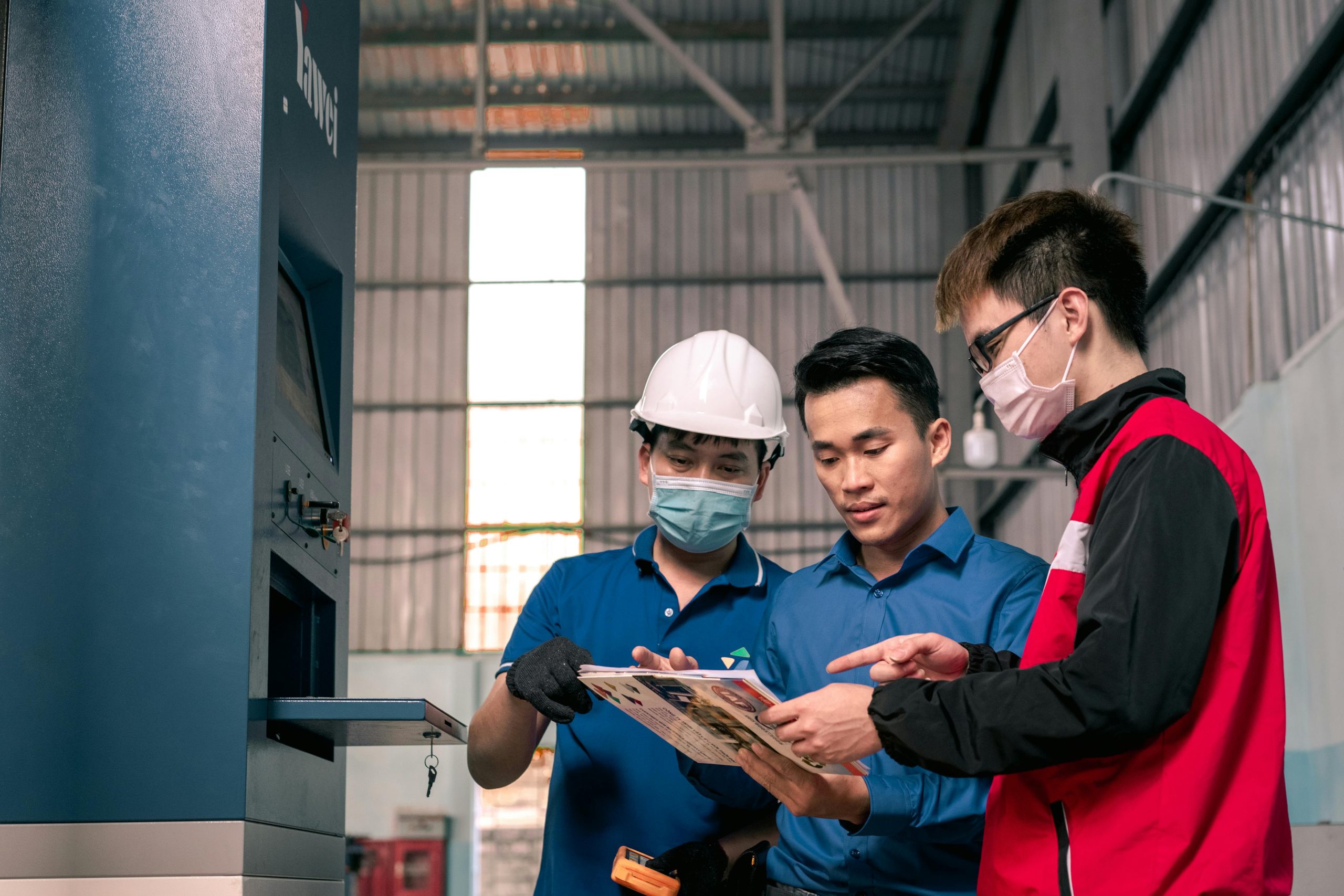
China has a mature, widely accessible third-party QC and inspection industry that Vietnam’s manufacturing base has not yet replicated. For buyers managing quality remotely, this infrastructure gap is one of the most significant practical risks of Vietnam sourcing and one that rarely appears in cost comparisons.
6.1) Third-Party QC Infrastructure: China vs Vietnam
China’s QC ecosystem is the most developed in the world for a manufacturing country:
- SGS, Bureau Veritas, and Intertek all have extensive China networks with offices in every major manufacturing hub
- Hundreds of local inspection agencies provide cost-competitive alternatives with English-speaking inspectors
- AQL (Acceptable Quality Level) sampling is a standardized methodology understood by virtually every Chinese factory and inspection agency
- Factory audit services are readily available across all manufacturing regions, including secondary cities
Vietnam’s inspection infrastructure is concentrated in Ho Chi Minh City and Hanoi, with limited coverage of secondary manufacturing zones. For buyers sourcing from factories in Vietnam’s northern industrial corridors (Haiphong, Bac Ninh) or smaller provincial zones, accessing third-party QC can require additional planning and higher per-inspection cost.
6.2) Pre-Shipment Inspection: What Changes When You Source from Vietnam
Pre-shipment inspections for furniture imports and other product categories in Vietnam are possible but require more lead time and typically cost more per inspection than equivalent China inspections. Language is a practical barrier — China’s Mandarin-language business ecosystem has produced a large pool of multilingual inspectors; Vietnam’s inspection industry is smaller and English proficiency among factory-floor contacts is more variable.
Factory audit standards are also less uniform in Vietnam. In China, a factory presenting for a third-party audit has typically undergone multiple audits previously and understands the process. In Vietnam — particularly with factories established primarily to serve tariff arbitrage rather than genuine export capability — the audit process can be less structured.

6.3) Red Flags to Watch for in Vietnamese Supplier Proposals
When reviewing a Vietnamese supplier’s credentials, watch for these warning signs — many of which also indicate potential origin washing. For a broader checklist, see our guide on red flags when dealing with a new manufacturer.
- No factory audit history: Legitimate Vietnamese exporters will have undergone audits by or for major customers. An absence of any audit record is a red flag.
- Unable to provide raw material sourcing documentation: Vietnamese factories should be able to document where their inputs are sourced. Refusal or inability to provide this raises origin washing concerns.
- Chinese-language internal documents: Internal production records, quality sheets, or supplier correspondence appearing in Chinese rather than Vietnamese suggests the operation may be Chinese-controlled.
- Claims of full Vietnamese manufacture for complex products: Electronics, precision metalwork, or technically sophisticated goods that Vietnam lacks deep industrial capability to produce entirely.
- Newly established factory with no production history: Factories set up after 2018 (post-Section 301 tariffs) for categories with high tariff differentials warrant extra scrutiny.
- Refusal to allow third-party factory audits: Any supplier unwilling to permit a third-party audit inspection should be disqualified immediately.
7) Supplier Vetting and Sourcing Infrastructure: Sourcing from Vietnam vs China
China has a mature, internationally accessible sourcing infrastructure — Alibaba, Made-in-China.com, Canton Fair, and a nationwide agent network — that Vietnam’s manufacturing sector has not yet developed. Buyers moving sourcing to Vietnam should expect a more manual, higher-effort supplier discovery and vetting process than they are accustomed to in China.
7.1) China’s Sourcing Ecosystem vs Vietnam’s
China’s sourcing infrastructure is the most developed in the world for international buyers. If you want to understand what that ecosystem looks like in practice, our guide on how to find reliable suppliers in China covers the full process.
- Alibaba and Made-in-China.com: Comprehensive B2B directories with millions of verified Chinese suppliers, English-language interfaces, and built-in verification tools
- Canton Fair (Guangzhou): Twice-yearly international trade show — the world’s largest — attracting buyers from 200+ countries and giving direct access to thousands of manufacturers
- Global Sources: Additional B2B platform with English-language supplier listings and trade show events
- Nationwide sourcing agent network: Thousands of sourcing agents across China’s manufacturing regions with English-language capability and established factory relationships
Vietnam has no equivalent B2B directory, no major international trade show comparable to Canton Fair, and a thinner network of English-speaking sourcing agents. Buyers transitioning from China sourcing often significantly underestimate how much infrastructure they are leaving behind.
7.2) Minimum Order Quantities: What to Expect From Vietnamese Factories
Minimum order quantities in Vietnam differ by product category and factory type:
- For textiles and apparel: MOQs are generally comparable to Chinese factories — Vietnam’s established garment industry has the scale to accommodate flexible order sizes
- For furniture and home goods: MOQs are often higher than Chinese equivalents, reflecting smaller production capacity and less flexible manufacturing lines in Vietnamese factories
- For electronics and complex products: MOQs can be significantly higher, and ramp-up time is longer, as Vietnamese factories lack the component supply chain depth to run efficient small batches
- For custom products requiring tooling: Development lead times are typically longer in Vietnam, and factories may require a larger minimum commitment to justify the tooling investment
7.3) How to Verify Supplier Legitimacy: Country-Specific Differences
If you are vetting a Vietnamese supplier, here are the verification steps we recommend:
- Ministry of Planning and Investment business registration check: Verify the company’s legal registration status through Vietnam’s National Business Registration Portal
- Third-party factory audit: Commission an independent audit from a reputable agency (SGS, Bureau Veritas, or a regional specialist) — do not rely on the supplier’s self-reported information
- Raw material sourcing verification: Request documentation of key input sourcing to screen for origin washing risk
- Trade references: Request contact details for existing international customers and conduct reference checks
- Production capacity verification: Confirm the factory has the equipment, workforce, and production history to manufacture your product at the required volume
For China supplier verification, the process differs — SAMR business registration checks, Alibaba Gold Supplier status, and Canton Fair participation records are all useful verification tools. Our guide on how to confirm a Chinese manufacturer is legitimate covers the full process.
8) Shipping and Lead Times: The Full Picture Beyond Freight Rates
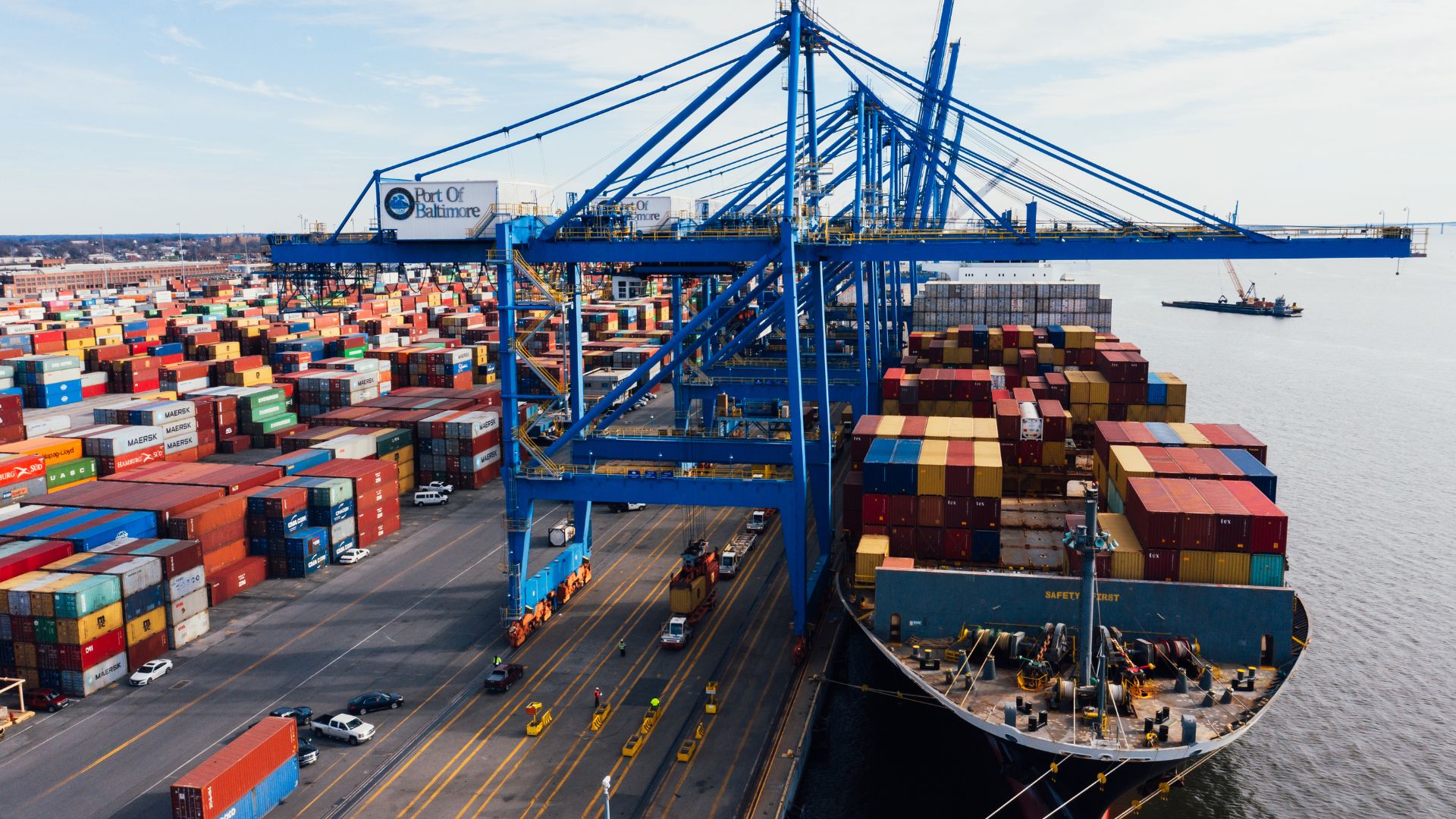
Lead time comparisons between China and Vietnam must account for production capacity, raw material sourcing, port infrastructure, and seasonal shutdowns — not just transit days. Vietnam’s shipping infrastructure is less developed than China’s, and its manufacturing base depends heavily on Chinese raw material inputs, which creates a risk that buyers often overlook.
8.1) Freight Costs and Transit Times: China vs Vietnam
For detailed guidance on freight cost components, see our guide on shipping costs from China. The table below compares key shipping routes.
Freight and Lead Time Comparison — China vs Vietnam Key Routes
| Route | Sea Transit Time (approx.) | Freight Cost Indicator | Port Infrastructure | Notes |
|---|---|---|---|---|
| China (Shanghai/Ningbo) → UK | 25–30 days | Competitive (high vessel frequency) | Excellent | Multiple direct sailings weekly from world’s busiest ports |
| China (Shanghai) → US West Coast | 14–18 days | Competitive | Excellent | High frequency, established lanes — benchmark route for comparison |
| China (Shenzhen) → Australia | 18–25 days | Competitive | Excellent | Well-served lane with multiple carrier options |
| Vietnam (Ho Chi Minh City / Cai Mep) → UK | 28–35 days | Moderate premium vs China | Good (improving) | Fewer direct sailings; some transhipment via Singapore adds time |
| Vietnam (Haiphong / Ho Chi Minh City) → US West Coast | 18–22 days | Moderate premium vs China | Good | Growing but fewer direct sailings; carrier options narrower than China |
Source: Freightos Baltic Index and carrier schedule data, 2025. Transit times and freight costs vary by season, vessel availability, and specific port. Verify current rates with your freight forwarder.
8.2) Vietnam’s Dependency on Chinese Raw Materials
A significant share of Vietnam’s manufacturing inputs — including raw materials, components, and machinery — are sourced from China, meaning disruptions to Chinese supply chains can cascade into Vietnamese production delays.
This is the structural irony of the China Plus One strategy as it is currently implemented in Vietnam. For product categories like electronics (where Vietnam imports Chinese-made PCBs and components), furniture (where Vietnamese factories import Chinese hardware and semi-finished timber products), and textiles (where synthetic fabric inputs often originate in China), the “de-risking” from Chinese supply chains is partial at best.
Buyers should specifically ask Vietnamese suppliers what percentage of their inputs are sourced from China — and factor this into their supply chain risk assessment.
8.3) Production Lead Times: Chinese New Year vs Tet Holiday
Both countries experience major production shutdowns that affect order planning. For comprehensive guidance on managing production timing, see our guide on strategies to minimise shipping delays for furniture imports.
- Chinese New Year (January–February): Well-documented 2–4 week factory shutdown — Western buyers have adapted their order calendars to this cycle
- Vietnam’s Tet holiday (same period): Vietnamese factories shut down for a similar duration at the same time of year, meaning dual-country sourcing strategies do not eliminate the seasonal shutdown risk — both suppliers are closed simultaneously
9) IP Protection and Legal Risk: China vs Vietnam in 2026
China’s IP enforcement has improved significantly and is now more developed than Vietnam’s for commercial disputes — buyers who assume Vietnam offers better IP protection than China are often mistaken. Proper legal agreements and pre-production IP registration remain essential in both countries.
9.1) China’s IP Landscape in 2026: Better, But Still Real Risks
China has made substantial progress on IP enforcement over the past decade. Current developments include:
- Dedicated IP courts: China established specialized IP courts in Beijing, Shanghai, and Guangzhou — these courts handle cases efficiently by international standards
- First-to-file trademark system: Register your trademark in China before any other party — a Chinese supplier or copycat — does so first
- Improved patent enforcement: China’s IP courts have been granting damages awards that increasingly reflect actual commercial harm
Real risks remain, particularly at the product development and sampling stage. For practical guidance, see our detailed guides on how to protect your IP when manufacturing in China and the truth about intellectual property in China. Key practical mitigations include:
- NNN agreements (Non-Disclosure, Non-Use, Non-Circumvention) — not Western-style NDAs, which are difficult to enforce in China
- Trademark registration in China before sharing designs or specifications with any factory
- Clear IP ownership clauses in all supply contracts, governed by Chinese law and with Chinese jurisdiction

9.2) Vietnam’s IP Enforcement Reality
Buyers who move sourcing to Vietnam expecting stronger IP protection than China may be surprised — Vietnam’s IP enforcement infrastructure is less developed, with fewer specialized courts and slower enforcement mechanisms than China’s current system.
Vietnam has IP legislation in place and is a signatory to major international IP conventions, but enforcement is genuinely weaker in practice. The manufacturing base is younger, enforcement institutions are less experienced with commercial IP cases, and the practical barriers to pursuing an IP violation claim in Vietnam are higher than in China’s dedicated IP courts.
9.3) Contract Enforceability: What Importers Need to Know
China’s commercial court system is more developed and experienced in handling foreign buyer disputes than Vietnam’s equivalent. For either country, robust supply contracts are essential — see our guide on why you need a China purchase contract for the key contractual protections applicable to both markets. Always seek local legal review of supply agreements in both jurisdictions before committing to production.
Our QC team conducts factory audits across both China and Vietnam. What we consistently find is that Vietnamese factories established primarily for export — particularly those set up after 2018 — vary enormously in audit readiness. The Chinese factories we audit have typically been through this process many times. In Vietnam, it is not uncommon to find a factory with no audit history at all, no documented QC procedures, and limited English-language documentation. That is a risk profile buyers need to price into their decision.
How Easy Imex Helps You Make the Right Sourcing Decision
Making the right call between China vs Vietnam sourcing requires more than a wage comparison. It requires a full assessment of your product category, order volumes, tariff exposure, quality requirements, and total landed cost — exactly the kind of analysis we do for clients every day.
Easy Imex’s core expertise is China sourcing. We are honest about that. And that expertise is precisely what makes us effective at helping clients evaluate whether Vietnam is genuinely the right choice for their specific product — or whether they are better served by optimising their China supply chain instead.
Here is how we support importers working through this decision:
- China Sourcing Agent service: We find the right Chinese manufacturer for your product — including factories not listed on Alibaba or any English-language directory — and verify them through on-the-ground vetting before you commit
- Sampling and Quality Assurance: Pre-production QA confirms your product specs, assembly method, packaging, and quality expectations are locked in before mass production begins — in either country
- Quality Control and China Inspection: Our structured QC stack covers factory audits, mid-production inspections, pre-shipment AQL-based pass/fail inspections, and container loading checks — catching issues before they ship
- Purchasing China: Bilingual contracts, clearly defined specs, and payment terms tied to QC outcomes — so you are protected throughout the purchasing process
- Shipping coordination: Door-to-door shipping management, FCL/LCL consolidation for multi-supplier orders, and clear landed cost planning so you know your actual costs before goods leave the factory
If you are weighing China vs Vietnam for a specific product, the most useful first step is a sourcing consultation where we can give you a category-specific, cost-complete recommendation.
Get a Free China Sourcing Consultation
Frequently Asked Questions: China vs Vietnam Sourcing
Is Vietnam cheaper than China for manufacturing?
Vietnam has lower manufacturing wages than China, but total landed cost — including freight, tariffs, QC inspection, and inventory carrying costs from longer lead times — is often comparable or only marginally lower for most product categories. Labor savings alone are not a reliable proxy for total cost savings, and the gap is narrowing as Vietnamese wages rise faster in percentage terms than China’s.
What products are better to source from Vietnam vs China?
Vietnam is genuinely competitive for textiles, apparel, footwear, and simple labor-intensive assembly — categories where it has built real export manufacturing capability over 20+ years. China remains superior for furniture, electronics, metalwork, injection molding, and any product requiring custom tooling, complex multi-component assembly, or industrial clustering. For most technically complex products, China’s ecosystem advantage is decisive.
How do US tariffs affect China vs Vietnam sourcing costs?
US Section 301 tariffs on Chinese goods are significantly higher than Vietnam’s MFN tariff rates for most product categories, creating a real cost incentive to source from Vietnam — particularly for US importers. However, buyers must actively screen for origin washing (Chinese goods falsely claiming Vietnamese origin) to avoid CBP enforcement risk. The tariff saving is only legitimate when Vietnam is the genuine country of manufacture.
What is origin washing in Vietnam sourcing?
Origin washing (also called tariff washing) is the practice of routing Chinese-made goods through Vietnam with minimal local processing to falsely claim Vietnamese origin and avoid US tariffs on Chinese imports. Chinese factories open Vietnamese operations, import semi-finished goods from China, perform minimal processing, and ship claiming Vietnamese origin. This exposes buyers to CBP anti-circumvention enforcement, including goods seizure and back-payment of duties.
Is Vietnamese product quality as good as Chinese manufacturing?
Quality depends heavily on product category. For textiles and footwear, Vietnamese quality is well-established and trusted by major global brands. For complex manufactured goods — furniture, electronics, metalwork, precision plastics — China’s deeper industrial expertise, accumulated workforce specialization, and mature QC infrastructure typically delivers more consistent quality. Category-specific assessment is always essential before drawing quality conclusions.
What are the biggest risks of sourcing from Vietnam instead of China?
The key risks of Vietnam sourcing include: weaker and less geographically distributed QC and inspection infrastructure; a less developed supplier vetting and discovery ecosystem; origin washing compliance risk from CBP enforcement; Vietnam’s significant dependency on Chinese raw material inputs (which undermines de-risking rationale); smaller factory scale limiting MOQ flexibility for complex products; and less developed IP enforcement compared to China’s dedicated IP courts.
Can I use a China sourcing agent to source from Vietnam?
Some China sourcing agents have Vietnam capabilities, but buyers should verify that the agent has genuine on-the-ground presence, established supplier relationships, and local-language proficiency in Vietnam specifically. China sourcing expertise does not automatically transfer to Vietnam’s different manufacturing ecosystem, sourcing infrastructure, and language environment. Always ask for evidence of specific Vietnam sourcing history, not just general Asia capability.
Should I use a dual-country sourcing strategy with both China and Vietnam?
A dual-country China Plus One strategy can reduce both tariff exposure and supply chain concentration risk, but it adds sourcing complexity, higher management overhead, and splits order volumes across two supplier relationships. It works best for brands with sufficient volume to maintain meaningful relationships in both countries and for businesses that have products genuinely suited to both markets — for example, apparel in Vietnam and hardware in China.
How does China’s industrial clustering compare to what Vietnam offers?
China’s industrial clustering — entire supply chains co-located in specific regions like Foshan (furniture), Dongguan (electronics), and Yiwu (small commodities) — has no equivalent in Vietnam. Vietnam’s manufacturing is concentrated in two corridor zones (Hanoi/Haiphong and Ho Chi Minh City) but lacks the supply chain depth, specialist labor pools, and co-located component ecosystems that make China’s clusters so cost- and speed-efficient for complex products.
How do I find reliable suppliers in Vietnam if I cannot use platforms like Alibaba?
Vietnam has no B2B directory equivalent to Alibaba or Made-in-China.com, and no trade show comparable to China’s Canton Fair. Reliable supplier discovery in Vietnam requires working with a sourcing agent with genuine on-the-ground Vietnam presence, attending sector-specific trade shows (such as Vietnam International Textile and Garment Industry Exhibition for apparel), or engaging a trade consultancy with verified local factory networks. Budget more time and cost for Vietnam supplier discovery than you would for China.
Next Steps: Making Your China vs Vietnam Sourcing Decision
The China vs Vietnam sourcing decision is product-specific, volume-dependent, and cost-complete — and the right answer for your business is unlikely to be the same as the headline trend suggests. Here are three concrete next actions to take before committing to a sourcing strategy:
- Request a product-category assessment: Share your product category with Easy Imex and receive a specific recommendation on whether China, Vietnam, or a dual-country approach suits your product and volume. This cuts through the generic advice and gives you a decision anchored in your actual sourcing situation.
- Get a landed cost estimate: Use Easy Imex’s consultation to build a total landed cost comparison for your specific product — including freight, duties, QC cost, and lead time inventory carrying cost — before committing to a sourcing country. The math often looks different from the labor cost headline.
- Speak to a China sourcing specialist: Book a free consultation to discuss your current or planned sourcing strategy and whether Vietnam genuinely offers cost or risk advantages for your specific product category and buyer profile.

Conclusion: Make the Right Sourcing Decision With the Full Picture
The china vs vietnam sourcing question does not have a universal answer — and any guide that tells you otherwise is selling you something. Vietnam offers real advantages for specific product categories and specific buyer profiles. China offers structural advantages for complex, high-volume, and technically sophisticated manufacturing that Vietnam’s newer industrial base cannot yet match.
The buyers who make the best sourcing decisions are those who model the full cost, assess their specific product category honestly, screen rigorously for origin washing risk, and work with sourcing specialists who have genuine on-the-ground experience in both markets — not just a Wikipedia-level overview of wage rates.
If you want an honest, product-specific assessment of whether China, Vietnam, or a dual-country strategy is right for your business, our team is ready to help.
About the Author: Adam

- Introduction
- 1) Why the China vs Vietnam Sourcing Question Has Changed in 2025-2026
- 2) Labor Costs: China vs Vietnam Manufacturing in 2026
- 3) China vs Vietnam Manufacturing: What Each Country Does Best
- 3.1) Product Category Recommendation Matrix
- China vs Vietnam Sourcing — Product Category Recommendation Matrix (2026)
- 3.2) China’s Industrial Clustering Advantage
- 3.3) Where Vietnam Genuinely Wins: Textiles, Footwear, and Simple Assembly
- 3.4) Tooling, Molds, and Complex Manufacturing: Why China Still Leads
- 4) Tariffs and Trade Costs in 2026: The Real Numbers
- 5) Total Landed Cost: The Only Number That Actually Matters
- 6) Quality Control and Inspection: Vietnam Sourcing Risks vs China
- 7) Supplier Vetting and Sourcing Infrastructure: Sourcing from Vietnam vs China
- 8) Shipping and Lead Times: The Full Picture Beyond Freight Rates
- 9) IP Protection and Legal Risk: China vs Vietnam in 2026
- How Easy Imex Helps You Make the Right Sourcing Decision
- Frequently Asked Questions: China vs Vietnam Sourcing
- Is Vietnam cheaper than China for manufacturing?
- What products are better to source from Vietnam vs China?
- How do US tariffs affect China vs Vietnam sourcing costs?
- What is origin washing in Vietnam sourcing?
- Is Vietnamese product quality as good as Chinese manufacturing?
- What are the biggest risks of sourcing from Vietnam instead of China?
- Can I use a China sourcing agent to source from Vietnam?
- Should I use a dual-country sourcing strategy with both China and Vietnam?
- How does China’s industrial clustering compare to what Vietnam offers?
- How do I find reliable suppliers in Vietnam if I cannot use platforms like Alibaba?
- Next Steps: Making Your China vs Vietnam Sourcing Decision
- Conclusion: Make the Right Sourcing Decision With the Full Picture
- About the Author: Adam
- Leave A Comment Cancel reply