
TL;DR
- De minimis eliminated: Since May 2, 2025, all packages from China — regardless of value — require formal US customs entry and payment of applicable duties. The previous $800 duty-free threshold no longer applies to Chinese-origin goods.
- Section 301 tariffs: Most Chinese goods face a 25% additional duty on top of the standard MFN base rate. Certain categories such as electric vehicles face rates as high as 100% as of 2026.
- Tariffs stack: Your total duty burden is MFN base rate + Section 301 tariff + any applicable Anti-Dumping and Countervailing Duties (AD/CVD). For some products, this combined rate exceeds 50%.
- UFLPA enforcement: The Uyghur Forced Labor Prevention Act (UFLPA) bans goods linked to China’s Xinjiang region. CBP enforcement has intensified significantly in 2024–2026, affecting cotton, polysilicon, aluminium, and more.
- Customs bond required: All commercial imports valued over $2,500 require a US Customs Bond — a financial guarantee issued by a licensed surety company through your customs broker.
- Start upstream: The biggest import risks occur before your goods ship — at the supplier vetting, sampling, and pre-shipment inspection stages. Addressing compliance at the factory prevents costly CBP detainment.
- China still leads: Despite tariff pressure, China remains the dominant source for US importers across electronics, furniture, textiles, and machinery — and often remains price-competitive even after duties are factored in.
Importing from China to the US remains one of the most consequential trade relationships in the global economy — and in 2025–2026, it became significantly more complex. The United States imported $308.4 billion worth of goods from China in 2025 — down 29.7% from 2024 — according to the Office of the US Trade Representative, making China the largest single source of US goods imports. Yet the regulatory environment has shifted dramatically: the $800 de minimis exemption is gone for Chinese goods, UFLPA enforcement is intensifying, and Section 301 tariffs continue to stack on top of standard duty rates.
This guide covers everything importers need to know in 2026 — from calculating your total duty burden and navigating UFLPA compliance, to the step-by-step process from supplier vetting through US customs clearance. Whether you are a first-time importer, an Amazon FBA seller, an SMB buyer, or an experienced sourcing professional navigating new rules, this is the complete picture: not just what has changed, but what to do about it before your goods leave the factory.
1. The State of US–China Trade in 2026
1.1 How Much Does the US Still Import from China?
The United States imported $308.4 billion in goods from China in 2025 — down 29.7% from 2024 — according to the Office of the US Trade Representative, making China the largest single-country source of US goods imports. The top categories by value include:
- Electrical and electronic equipment: The single largest category, covering consumer electronics, components, and semiconductors
- Machinery and mechanical appliances: Industrial equipment, motors, and manufacturing tooling
- Furniture, bedding, and lighting: A major category facing significant AD/CVD exposure
- Textiles and apparel: Subject to UFLPA scrutiny given Xinjiang cotton supply chain concerns
- Plastics and plastic articles: Packaging, consumer goods, and industrial components
Despite years of tariff pressure, diversification initiatives, and geopolitical tension, China’s share of US imports has proven remarkably resilient — driven by manufacturing depth, supplier density, and price competitiveness that alternatives have not yet matched at scale.

1.2 Why China Remains the #1 Sourcing Option Despite Tariff Pressure
China’s manufacturing ecosystem is not simply a collection of factories — it is a vertically integrated supply chain where component suppliers, tooling manufacturers, packaging producers, and assembly facilities exist within close geographic proximity. This density is why China’s regional manufacturing hubs continue to outperform alternatives for most product categories.
- Guangdong province: The dominant hub for electronics, furniture, and consumer goods — home to Shenzhen’s tech ecosystem and Foshan’s furniture industry
- Yiwu (Zhejiang): The world’s largest small commodities market, supplying everything from holiday decorations to stationery
- Zhejiang province (broader): A powerhouse for machinery, hardware, and mid-tech manufacturing
For many product categories, the landed cost from China — even after Section 301 tariffs — remains competitive with Vietnam or Mexico alternatives when tooling capability, MOQs, and supplier ecosystem depth are factored in. The calculus is shifting, but it has not yet flipped for most importers.
Read the Step-by-Step Import Guide
2. What Has Changed for US Importers in 2026?
2.1 The End of De Minimis for China Imports (May 2, 2025)
The US $800 de minimis exemption was eliminated for goods of Chinese origin on May 2, 2025. All packages shipped from China — regardless of value — now require formal customs entry and payment of applicable duties. This is one of the most significant structural changes for US importers in a generation.
De minimis exemption refers to the US trade rule under Section 321 of the Tariff Act that previously allowed goods valued at $800 or less to enter the United States duty-free and without formal customs entry. That exemption now applies only to goods originating from countries other than China (and a small number of other designated countries). For Chinese-origin goods, there is no minimum threshold — a $5 package and a $5,000 shipment are treated identically by CBP.
Who is most affected by the de minimis elimination:
- E-commerce importers and Amazon FBA sellers who relied on low-value direct-from-factory shipments arriving duty-free
- DTC brands sourcing sample quantities or small top-up orders directly from Chinese manufacturers
- Small business buyers testing new product lines with modest initial orders
- Consumers purchasing directly from Chinese platforms such as Shein, Temu, or AliExpress — all packages now subject to formal entry and duties
For official CBP guidance on the de minimis change, refer to the CBP de minimis guidance page.
2.2 UFLPA Enforcement: What the Uyghur Forced Labor Prevention Act Means for Your Imports
The Uyghur Forced Labor Prevention Act (UFLPA), signed into law in December 2021 and enforced from June 2022, establishes a rebuttable presumption that any goods mined, produced, or manufactured wholly or in part in China’s Xinjiang region — or by entities on the UFLPA Entity List — are made with forced labor and are therefore prohibited from entry into the United States.
The rebuttable presumption standard means CBP does not need to prove forced labor occurred. Instead, the importer must prove it did not — a significant and often difficult evidentiary burden. CBP enforcement has intensified significantly in 2024–2026, with more shipments detained and a growing Entity List.
Product categories most affected by UFLPA scrutiny:
- Cotton and textiles: Xinjiang produces approximately 85% of China’s cotton — any cotton-content garment or textile faces supply chain documentation requirements
- Polysilicon and solar panels: Xinjiang is a major polysilicon production region, creating exposure across the solar supply chain
- Aluminium products: Xinjiang-linked aluminium smelting operations are on the Entity List
- Tomato products: Processed tomatoes from Xinjiang are a designated high-risk category
Importers must be able to document that their supply chain does not trace to Xinjiang or UFLPA-listed entities. This requires supplier audits, material traceability records, and in some cases third-party supply chain mapping. Refer to the official CBP UFLPA portal for the current Entity List and guidance documentation.
When a shipment is detained under UFLPA, importers are often shocked by how quickly costs escalate — storage fees, legal documentation costs, and the risk of abandonment can make a detained container far more expensive than the goods inside it. The time to address Xinjiang supply chain risk is before you place your purchase order, not after your shipment arrives at the port.
3. How Do Section 301 Tariffs Work and What Do They Cost?
3.1 What Is a Section 301 Tariff?
Section 301 tariffs are additional import duties imposed by the US government on goods originating from China under Section 301 of the Trade Act of 1974, following a USTR investigation into China’s trade practices. Most Chinese goods subject to these tariffs carry a 25% additional duty rate on top of the standard MFN (Most Favoured Nation) base rate. Certain categories — including electric vehicles — face rates as high as 100% as of 2026, per USTR Section 301 tariff schedules.
3.2 How Tariffs Stack: MFN + Section 301 + AD/CVD
The critical concept for any importer is that US duties on Chinese goods are not a single rate — they stack. Your total duty burden is the sum of three potential layers:
- MFN base rate: The standard duty rate that applies to all imports of that product category, regardless of origin — determined by the HS code and found in the USITC Harmonized Tariff Schedule
- Section 301 tariff: The additional China-specific duty imposed by the USTR — 25% for most goods, higher for specific categories
- AD/CVD (if applicable): Product-specific anti-dumping or countervailing duties applied separately on top of both rates above
Understanding this stacking mechanism is essential before you commit to an order. Many first-time importers research the MFN rate and assume that is their duty — only to discover at customs that Section 301 and AD/CVD add another 30–50+ percentage points to their total cost. Always calculate your calculating your total landed cost using all three layers before placing an order.
How US Import Duties Stack for Chinese Goods
A note on Section 122 tariffs (updated July 2026): Beyond the layers below, a temporary 10% Section 122 surcharge on imports from most countries, including China, took effect on February 20, 2026. On May 7, 2026, the US Court of International Trade ruled this surcharge unlawful — but per CBP guidance it remains in effect and continues to be collected pending appeal. It is scheduled to expire on July 24, 2026 regardless of the appeal’s outcome. Because its legal status is unresolved and it is time-limited, we have not baked it into the combined rates in the table below. Confirm its current status at ustr.gov or with your customs broker before calculating landed costs.
| Product Category | HS Chapter | MFN Base Rate | Section 301 Tariff | AD/CVD (if applicable) | Combined Duty Burden |
|---|---|---|---|---|---|
| Consumer Electronics (e.g. smartphones) | Ch. 85 | 0% | 25% | None active | ~25% |
| Machinery (industrial equipment) | Ch. 84 | 0–3.5% | 25% | None (most categories) | ~25–28.5% |
| Wooden Furniture | Ch. 94 | 0% | 25% | Active AD order (wooden bedroom furniture: varies by producer) | 25%+ AD/CVD |
| Apparel and Textiles | Ch. 61–62 | 12–32% | 25% | None (most categories) | ~37–57% |
| Steel Products | Ch. 72–73 | 0–6.5% | 25% | Active AD/CVD orders — rates vary widely by product | 25%+ AD/CVD |
| Solar Panels (crystalline silicon) | Ch. 85 | 0% | 50% | Active AD/CVD orders | 50%+ AD/CVD |
| Electric Vehicles | Ch. 87 | 2.5% | 100% | None currently active | ~102.5% |
| Rubber Tyres | Ch. 40 | 3.4–4% | 25% | Active AD/CVD orders | 28–29%+ AD/CVD |
Sources: USTR Section 301 tariff schedules (ustr.gov), USITC AD/CVD orders database (usitc.gov), CBP Harmonized Tariff Schedule (hts.usitc.gov). Rates verified as of July 2026 and exclude the contested Section 122 surcharge (see note above). AD/CVD rates vary by producer and are subject to annual reviews. Tariff policy is changing rapidly in 2026 — always verify current rates with a licensed customs broker before placing an order.
3.3 Anti-Dumping and Countervailing Duties: Which Chinese Products Are High Risk?
Anti-Dumping and Countervailing Duties (AD/CVD) are product-specific import duties applied on top of MFN and Section 301 rates when the US Department of Commerce finds that Chinese goods are sold below fair market value (anti-dumping) or benefit from Chinese government subsidies (countervailing). AD/CVD rates are assessed separately and can exceed 200% for certain product categories, per the USITC AD/CVD orders database.
High-risk product categories with active AD/CVD orders on Chinese goods:
- Wooden bedroom furniture: One of the longest-running and most significant AD orders — rates vary by named producer vs. non-reviewed producers (potentially very high)
- Mattresses: Active AD/CVD orders with significant rates
- Steel products: Multiple active orders covering hot-rolled steel, cold-rolled steel, steel pipe, and wire rod
- Aluminium extrusions: Major AD/CVD orders covering a wide range of extruded aluminium profiles
- Solar panels and cells: Active and significant AD/CVD orders on crystalline silicon photovoltaic products
- Rubber tyres: Active orders covering passenger vehicle and light truck tyres
- Paper products: Active orders on certain coated paper and uncoated groundwood paper
Always verify whether your specific product category has an active AD/CVD order by searching the USITC AD/CVD orders database before committing to a China source for that product.

The tariff stacking problem catches first-time importers off guard more than anything else we see. A buyer researches a 0% MFN rate on electronics components, assumes they are getting a good deal, and then gets hit with 25% Section 301 on top. If there is also an AD/CVD order on that specific product, the final duty can be three to four times what they budgeted. Always calculate the full stack — not just the MFN rate — before your purchase order is finalised.
4. How to Calculate Your Total Customs Duty from China to the USA
4.1 The Landed Cost Formula for China Imports
Landed cost is the total cost of importing a product from China to a US destination. It is not just the product price — it is every cost incurred from factory gate to your warehouse door. Use this formula for every order:
- Product Cost (FOB): The price you pay your Chinese supplier, typically quoted FOB (Free On Board) at the origin port
- + International Freight: Ocean freight (FCL or LCL) or air freight from China port to US port of entry
- + Insurance: Cargo insurance for the international leg — typically 0.3–0.5% of cargo value
- + Customs Duties: MFN base rate + Section 301 tariff + any applicable AD/CVD, calculated on the customs value (generally CIF value at US port)
- + Customs Broker Fee: Typically $150–$400 per shipment for a licensed US customs broker
- + ISF Filing Fee: Importer Security Filing (10+2), typically $25–$50 per shipment
- + Inland Freight (Drayage): Transport from the US port to your warehouse or fulfilment centre
Total Landed Cost = Product Cost + Freight + Insurance + Customs Duties + Broker Fee + ISF Fee + Inland Freight
Use the USITC Harmonized Tariff Schedule tool to look up your product’s HS code and MFN duty rate before calculating.
4.2 A Worked Example: Importing Furniture from Guangdong to Los Angeles
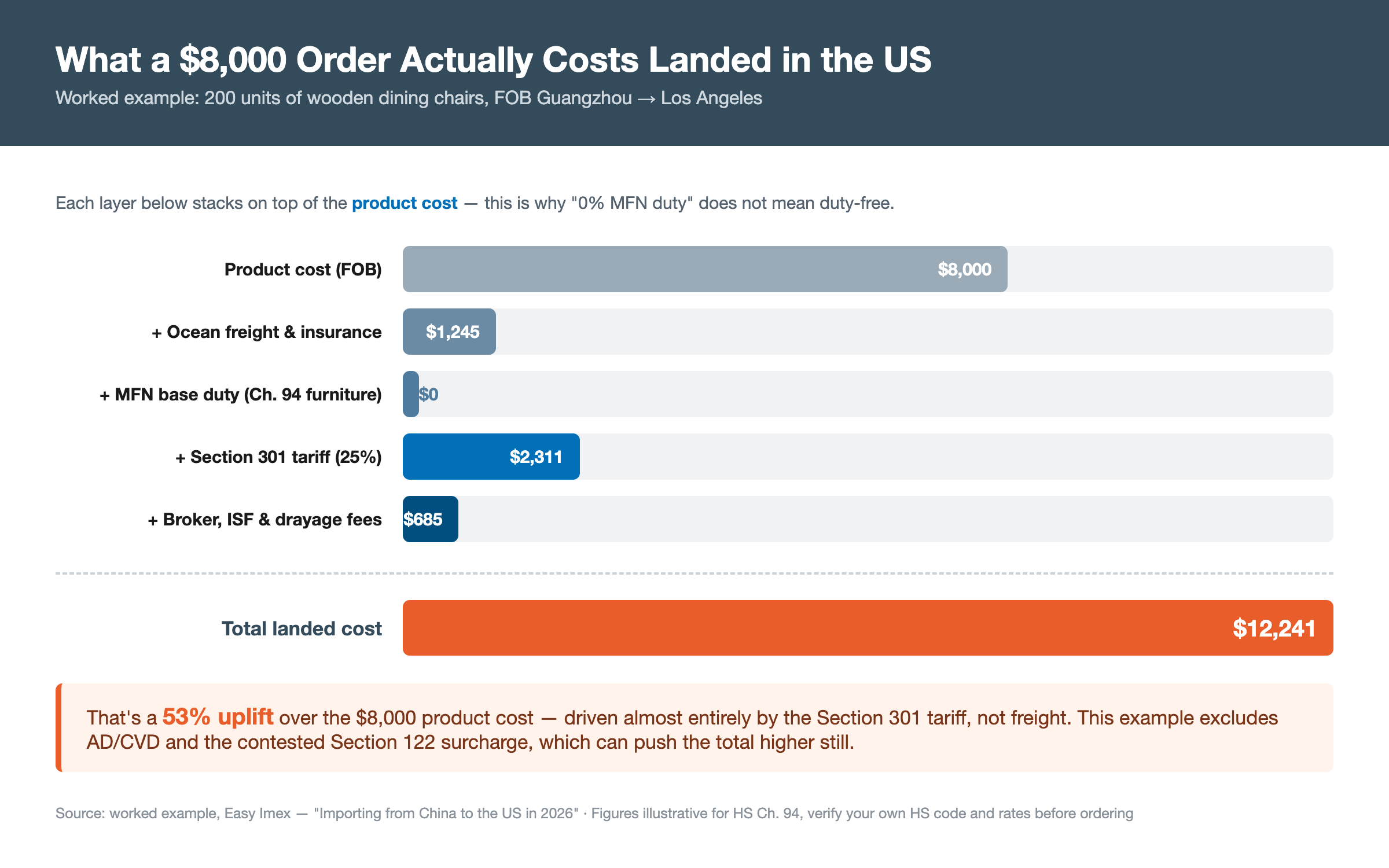
The following is an illustrative example using representative values. Actual rates will vary by HS code, supplier, and current AD/CVD orders — always verify with a licensed customs broker.
- Product cost (FOB Guangzhou): $8,000 for 200 units of wooden dining chairs
- + Ocean freight (LCL, Guangzhou to Los Angeles): Approximately $1,200
- + Cargo insurance: ~$45 (0.5% of $9,200 CIF value)
- + Customs value: $9,245 (CIF: product + freight + insurance)
- + MFN duty (Ch. 94 furniture): 0% of $9,245 = $0
- + Section 301 tariff (25%): $9,245 × 25% = $2,311
- + AD/CVD (wooden furniture, if applicable): Varies — assume $0 for this example if no active order applies to your specific item
- + Customs broker fee: ~$250
- + ISF filing: ~$35
- + Drayage (Los Angeles port to warehouse): ~$400
Total Estimated Landed Cost: ~$12,241 — compared to $8,000 FOB product cost. That is a landed cost uplift of approximately 53%, driven primarily by freight and Section 301 duties.
This example does not include any AD/CVD exposure. If the specific furniture item is subject to an active anti-dumping order, the total could be significantly higher. Always verify your HS code and AD/CVD status before finalising your landed cost calculation.
Get a Landed Cost Estimate for Your Product
5. How to Import from China to the USA: Step-by-Step Process
Step 1 — Find and Vet a Legitimate Chinese Supplier
Your import compliance journey begins with your supplier, not your shipping agent. The platforms most commonly used to identify Chinese manufacturers include Alibaba, Global Sources, and trade shows such as the Canton Fair. However, listing on a platform does not verify legitimacy.
- Business licence verification: Request and verify the supplier’s Chinese business licence (营业执照) through official channels
- Factory audit: Conduct an on-site or third-party audit before placing a bulk order
- Sample order first: Never skip the sample stage — it is your only quality verification before production commits
- UFLPA pre-check: Confirm your supplier is not located in Xinjiang and is not on the UFLPA Entity List before any purchase agreement is signed
Start by verifying a Chinese manufacturer’s legitimacy before committing to any order.
Step 2 — Negotiate Terms, Payment, and a Written Contract
Payment terms and contract protections are often where inexperienced importers lose the most money. Standard China payment structures are typically 30% deposit upfront and 70% against shipping documents — though terms vary by supplier relationship and order size.
- T/T (Telegraphic Transfer): Most common — 30/70 or 50/50 split tied to production milestones
- Letter of Credit (LC): Offers greater protection for large orders but adds bank costs and complexity
- Written purchase contract: Non-negotiable — must specify product specs, payment terms, delivery timelines, and dispute resolution
Learn about negotiating payment terms with Chinese suppliers and why protecting yourself with a China purchase contract matters before any money changes hands.

Step 3 — Develop Samples and Lock In Product Specifications
Production samples are the bridge between what you agreed in writing and what will actually be mass-produced. Do not approve bulk production without signed-off specifications tied to an approved sample.
- Pre-production sample: Confirms the factory understands your specifications before tooling is cut
- Production sample: Confirms early-run quality before full production proceeds
- Specification sign-off: A written record of the approved sample protects you in any quality dispute
Read what importers must know about product samples before placing your first bulk order.
Step 4 — Conduct a Pre-Shipment Inspection Before Goods Move
A pre-shipment inspection (PSI) is a quality audit conducted at the factory before goods are packed for export — typically when 80–100% of production is complete. This is the most important risk-reduction step in the entire import process.
- AQL-based sampling: Tests a statistically significant sample of your goods against your approved specifications
- Packaging and labelling check: Confirms correct country-of-origin marking, safety labelling, and barcode accuracy — errors here cause CBP delays
- Compliance pre-check: Identifies non-compliant products before they are containerised — far cheaper than CBP detainment
The connection between factory-level quality control and import compliance is direct: goods that fail CBP inspection because of mislabelling or specification non-compliance are significantly more expensive to resolve than a pre-shipment inspection would have cost. Explore pre-shipment inspection services in China for your product category.
Step 5 — Choose Your Shipping Method: Sea Freight vs Air Freight
The cost-speed trade-off between sea and air freight is straightforward — but there are China-specific timing considerations that every importer must build into their planning calendar.
- Sea freight (FCL — Full Container Load): Most cost-effective for large orders; 20–35 days transit time from major Chinese ports to US West Coast
- Sea freight (LCL — Less than Container Load): Shares container space with other cargo; suitable for smaller orders but adds consolidation time and cost
- Air freight: 5–10 days transit; 4–8x more expensive per kg than sea; justified only for urgent, high-value, or lightweight shipments
China factory calendar alert: Chinese factories close for Chinese New Year (January/February) and Golden Week (October) — typically 2–4 weeks of shutdown. Build 3–4 extra weeks into your production and delivery timeline for orders placed in January or late September. Failure to account for the factory calendar is one of the most common causes of stock-out situations for US importers.
Compare sea freight vs air freight from China and understand FCL vs LCL container shipping before booking your shipment.
Step 6 — File Your ISF, Customs Bond, and Clear US Customs
US customs clearance involves several mandatory steps that must be completed in the correct sequence and timeline.
- ISF (Importer Security Filing): Also known as the “10+2 filing” — 10 data elements from the importer and 2 from the carrier. Must be submitted to CBP at least 24 hours before vessel departure from the origin port. Late or inaccurate ISF filing triggers a $5,000 penalty per violation.
- US Customs Bond: A US Customs Bond is a financial guarantee required by CBP for all commercial imports valued over $2,500. It ensures the importer will pay all applicable duties, taxes, and fees. Two types: single-entry bond (covers one shipment) or continuous bond (covers all shipments for 12 months — recommended for regular importers). Issued by a licensed surety company, typically through your customs broker.
- Customs broker: A CBP-licensed customs broker handles formal entry filing, HS code classification, duty payment, and communication with CBP on your behalf. Strongly recommended for all commercial imports — self-filing is legally permitted but errors are costly.
- Post-de minimis rule: As of May 2, 2025, all China-origin packages require formal CBP entry regardless of value — there is no low-value informal entry pathway for Chinese goods.
Avoid common errors that cause delays by reviewing avoiding customs documentation errors before your shipment departs.
Step 7 — Arrange Inland Delivery and Confirm Final Landed Cost
Once your goods clear CBP, drayage (container transport from the port to your warehouse or 3PL) is the final logistics step. This is also when your actual landed cost can be reconciled against your estimate.
- Drayage costs: Vary by port, distance, and congestion — confirm rates with your freight forwarder or customs broker before arrival
- Incoterms: If your goods were purchased on CIF terms, your supplier arranged freight and insurance — if FOB, you arranged these yourself. Understanding your Incoterms (FOB vs CIF) determines who owns cost and risk at each stage
- Final cost reconciliation: Compare actual duties assessed by CBP against your landed cost estimate — differences reveal whether your HS code classification, valuation, or duty calculation was accurate
Importing from China to the US — Step-by-Step Checklist
| Step | Action | Who Is Responsible | Key Documents / Tools | Common Pitfall |
|---|---|---|---|---|
| 1 | Find and vet supplier | Importer / Sourcing agent | Business licence, factory audit report, UFLPA Entity List check | Skipping audit; sourcing from Xinjiang-linked suppliers |
| 2 | Negotiate terms and sign contract | Importer / Sourcing agent | Purchase contract, payment confirmation | No written contract; paying 100% upfront |
| 3 | Develop and approve samples | Importer / Sourcing agent | Signed specification sheet, approved sample photos | Approving production without a signed sample sign-off |
| 4 | Pre-shipment inspection | QC inspector / Sourcing agent | AQL inspection report, packaging check | Skipping PSI to save cost — CBP detainment costs far more |
| 5 | Book and manage shipment | Freight forwarder | Bill of Lading, packing list, commercial invoice | Not accounting for factory calendar shutdowns |
| 6 | File ISF, bond, and clear customs | Customs broker | ISF filing, Customs Bond, Entry summary (CBP Form 7501) | Late ISF filing; incorrect HS code classification |
| 7 | Arrange inland delivery and reconcile costs | Importer / Freight forwarder | Drayage booking, final landed cost spreadsheet | Underestimating drayage and port congestion surcharges |
Source: Based on CBP import procedures and Easy Imex sourcing experience, 2026.
6. What Was the De Minimis Rule and Why Does Its Elimination Matter?
The US de minimis exemption allowed goods valued under $800 to enter the United States duty-free and without formal customs entry under Section 321 of the Tariff Act of 1930. This exemption was eliminated for goods of Chinese origin on May 2, 2025. All China-origin packages — regardless of value — now require formal CBP entry and full applicable duties, per CBP official guidance.
To understand why this matters, consider the scale: a significant portion of cross-border e-commerce packages from Chinese platforms such as Shein and Temu previously entered the US under the de minimis threshold, avoiding all duties. That pathway is now closed for Chinese-origin goods.
The practical impact varies significantly by importer type:
- E-commerce sellers (Amazon FBA, Shopify): Previously able to import small restocking shipments under $800 with no duties and minimal paperwork — now face full Section 301 duties and formal entry requirements on every shipment regardless of size
- DTC brands buying direct-from-factory: Sample orders and test batches previously entered duty-free — now subject to full MFN + Section 301 duty stack even on a 10-unit sample
- Small business buyers: Low-value trial orders that once had minimal import cost now carry the same duty burden as large commercial shipments
- Individual consumers: Direct consumer purchases from Chinese platforms now require duty payment — costs are typically passed through by the seller or collected at delivery
It is important to note that the $800 de minimis threshold still applies to goods originating from countries other than China (and a small number of other designated countries). If your supplier can legitimately ship from a non-Chinese-origin country (for example, a finished product manufactured in Vietnam from non-Chinese components), the exemption may still apply. However, goods must genuinely originate in that country — transshipment through a third country does not change country of origin for US customs purposes.
7. Is China Still Worth It? Comparing China vs. Vietnam, Mexico, and India
7.1 Where China Still Wins for US Importers
Despite tariff pressure, China’s manufacturing ecosystem advantages remain substantial for most product categories. The question is not “Is China expensive?” — it is “Is China expensive relative to the alternatives, all-in?” For many importers, the honest answer is still no.
China’s primary competitive advantages in 2026:
- Manufacturing ecosystem depth: Component suppliers, tooling manufacturers, and assembly facilities within close geographic proximity — drastically reducing lead times and MOQ requirements compared to building equivalent supply chains in Vietnam or India
- Tooling and customisation capability: China’s tooling industry is unmatched for custom products — metal injection moulding, die casting, injection moulding, and precision machining at scale
- Price competitiveness at volume: For high-volume orders in electronics, furniture, textiles, and machinery, the landed cost from China — even after 25% Section 301 duties — often remains lower than alternatives
- Supplier ecosystem maturity: Established quality management systems, export experience, and English-language capabilities are far more common in China’s export manufacturing sector than in emerging alternatives
China vs. Vietnam vs. Mexico — Sourcing Comparison for US Importers
| Factor | China | Vietnam | Mexico |
|---|---|---|---|
| Manufacturing capacity | Unmatched across all categories | Strong in textiles, footwear, electronics assembly | Strong in automotive, aerospace, appliances |
| Unit cost competitiveness | High at volume; Section 301 adds 25% | Competitive for labour-intensive goods; no Section 301 | Competitive, especially with USMCA duty advantages |
| Tariff environment (2026) | MFN + 25% Section 301 + potential AD/CVD | MFN rates only (no Section 301) | 0% for USMCA-qualifying goods |
| Lead times | 3–6 weeks production + 25–35 days sea freight | 4–8 weeks production + 20–28 days sea freight | 2–4 weeks production + 3–7 days ground transport |
| Supplier ecosystem depth | Extensive — virtually all product categories | Growing but shallow outside core categories | Deep in specific sectors; limited in consumer goods |
| IP risk | Moderate — mitigated with proper contracts and audits | Moderate | Lower — stronger IP enforcement environment |
| Best for | Electronics, furniture, machinery, consumer goods at volume | Apparel, footwear, electronics assembly, UFLPA-sensitive categories | Speed-to-market, USMCA-qualifying goods, automotive |
Source: Easy Imex sourcing analysis, 2026. Tariff data: USTR.gov. Lead time estimates are representative ranges and vary by supplier and product category.
7.2 When Nearshoring to Mexico or Vietnam Makes Sense
There are genuine scenarios where moving sourcing away from China — or running parallel supply chains — makes business sense in 2026.
- UFLPA supply chain risk: If your product category uses cotton, polysilicon, aluminium, or other Xinjiang-adjacent inputs, the documentation burden and detainment risk may make a Vietnam or other non-China source preferable
- Speed to market (Mexico): For US brands that need rapid replenishment or want to reduce inventory carrying risk, Mexico’s proximity — 3–7 days by ground versus 30+ days by sea from China — offers a structural advantage that tariff savings cannot always offset
- USMCA duty advantage: Goods qualifying under the United States-Mexico-Canada Agreement enter the US at 0% duty — a significant advantage for price-sensitive product categories where 25% Section 301 tariffs materially affect margin
- Tariff-sensitive high-volume products: At very high order volumes, the compounding effect of Section 301 + AD/CVD can make Vietnam or Mexico financially attractive even after accounting for higher unit costs
The practical reality for most importers is that supply chain diversification does not mean supply chain replacement. Running parallel China and Vietnam sourcing — using China for tooling-intensive or high-volume products and Vietnam for labour-intensive or tariff-sensitive categories — is increasingly the norm for sophisticated US importers.
8. Product Compliance Requirements for US Imports from China
CBP customs clearance is only the first compliance hurdle. Once your goods clear customs, they must also comply with the regulations of the relevant US product safety, health, and communications agencies. Non-compliance at this layer can result in product recalls, civil penalties, or import bans — and CBP itself may detain shipments where required documentation is missing.
For a comprehensive breakdown, refer to our full guide to product compliance for China imports. The table below summarises key requirements by product category.
US Product Compliance Requirements by Category for China Imports
| Product Category | Regulatory Body | Key Requirement | Documentation Needed | Consequences of Non-Compliance |
|---|---|---|---|---|
| Electronics and wireless devices | FCC (Federal Communications Commission) | FCC authorisation (certification, declaration of conformity, or verification) before import or sale | FCC ID, test reports, Declaration of Conformity | Import detention, seizure, civil monetary forfeiture |
| Children’s products | CPSC (Consumer Product Safety Commission) | Third-party testing against ASTM F963 (toy safety) and all applicable mandatory standards; Children’s Product Certificate (CPC) required | CPC, accredited lab test reports, tracking label | Mandatory recall, civil penalties up to $15.15M per violation series |
| Food and dietary supplements | FDA (Food and Drug Administration) | FDA Prior Notice required before arrival; facility registration under FSMA; HACCP compliance | Prior Notice confirmation, facility registration number | Refusal of entry, product destruction at importer’s cost |
| Cosmetics and personal care | FDA | Cosmetic facility registration and product listing (mandatory from 2024 under MoCRA); no unapproved colour additives or prohibited ingredients | Facility registration, product listing, ingredient safety documentation | Import alert, refusal of admission, product detention |
| Furniture and textiles | CPSC / California OEHHA (Prop 65) | CPSC safety standards compliance; Proposition 65 warning requirements for California sales if product contains listed chemicals above threshold | Test reports for formaldehyde (CARB ATCM), phthalates, lead; Prop 65 warning labels | California civil penalties (up to $2,500 per day per violation); CPSC enforcement action |
| Medical devices | FDA | Device registration and listing; 510(k) clearance or PMA approval for Class II/III devices; FDA Prior Notice | FDA establishment registration, device listing, 510(k) or PMA documentation | Import detention, refusal of admission, criminal liability for repeat violations |
Sources: FDA.gov, FCC.gov, CPSC.gov official guidance. Requirements are subject to regulatory updates — verify current requirements with the relevant agency before importing.

How Easy Imex Helps You Import from China with Less Risk
When importing from China to the US, your three biggest risks are supplier fraud, non-compliant products stopped at CBP, and underestimating your true duty burden. A China sourcing agent addresses all three before your goods leave the factory.
Easy Imex’s sourcing-first approach covers the entire journey upstream of where freight forwarders and logistics providers begin. Here is what that means in practice:
- China Sourcing Agent service: Our on-the-ground team in China identifies and verifies legitimate manufacturers — including factories not listed on Alibaba or English-language platforms. We separate trustworthy suppliers from those who present compliance and quality risks, including UFLPA-adjacent sourcing exposures.
- Purchasing and bilingual contracts: We manage the purchasing process with verified suppliers using bilingual purchase contracts, clearly defined product specifications, and payment terms tied to quality outcomes. We negotiate in RMB where possible to reduce currency exposure and improve pricing.
- Sampling and Quality Assurance: Before mass production is approved, we confirm your product specifications, assembly methods, packaging requirements, and full customer experience expectations against a pre-production sample — preventing costly errors from being scaled across an entire production run.
- Quality Control and Pre-Shipment Inspection: Our structured QC stack includes factory audits, mid-production inspections, and AQL-based pre-shipment inspections. We catch non-compliant or off-specification goods in China, before they reach CBP — where the cost of a problem multiplies dramatically.
- Shipping and Landed Cost Planning: We coordinate door-to-door shipping including FCL and LCL options, multi-supplier consolidation, insurance, and transparent landed cost estimation — so your true total cost is visible before you commit to an order.
To understand what to look for when selecting a sourcing partner, read our guide on what to look for in a China sourcing company.
Get a Free China Sourcing Consultation
Frequently Asked Questions: Importing from China to the US
Are there tariffs on orders under $800 from China?
Yes. The $800 de minimis exemption was eliminated for Chinese-origin goods effective May 2, 2025, per CBP official guidance. All packages from China — regardless of value — now require formal CBP customs entry and payment of applicable duties, including the standard MFN rate plus the 25% Section 301 tariff. The $800 duty-free threshold still applies to goods originating from most other countries, but not for Chinese-origin goods.
How much customs duty will I pay from China to the USA?
Your total duty burden on Chinese goods is calculated as: MFN base rate (product-specific, typically 0–32% depending on HS code) + Section 301 tariff (25% for most Chinese goods, up to 100% for electric vehicles) + any applicable Anti-Dumping and Countervailing Duties (AD/CVD), which vary by product and can exceed 200%. The specific rate depends on your product’s HS code classification and whether an AD/CVD order exists for that category. Use the USITC HTS tool at hts.usitc.gov to look up your HS code and MFN rate, then add the applicable Section 301 rate.
What is the Uyghur Forced Labor Prevention Act and how does it affect my imports?
The Uyghur Forced Labor Prevention Act (UFLPA) is a US federal law signed in December 2021, enforced from June 2022, that establishes a rebuttable presumption that goods made wholly or in part in China’s Xinjiang region are produced with forced labor and are banned from US import. The most affected categories include cotton and textiles, polysilicon and solar panels, aluminium products, and processed tomatoes. To rebut the presumption, importers must provide supply chain documentation tracing their goods away from Xinjiang and away from UFLPA Entity List companies. CBP enforcement has intensified significantly in 2024–2026. Visit the official CBP UFLPA portal at cbp.gov/trade/forced-labor/UFLPA for the current Entity List.
Do I need a customs broker to import from China?
A customs broker is not legally required for self-filers, but is strongly recommended for all commercial imports from China. Commercial imports over $2,500 require formal entry, which includes ISF filing, correct HS code classification, proper customs valuation, duty payment, and CBP communication. A CBP-licensed customs broker handles all of these. Customs broker fees are typically in the range of $150–$400 per shipment. Errors in self-filing — including incorrect HS code classification or late ISF submission — can result in delays, penalties of up to $5,000 per violation, or shipment detainment.
What is a customs bond and do I need one?
A US Customs Bond is a financial guarantee required by CBP for all commercial imports valued over $2,500. It ensures the importer will pay all applicable duties, taxes, and fees and comply with CBP regulations. There are two types: a single-entry bond (covers one shipment) and a continuous bond (covers all shipments for a 12-month period — recommended for importers shipping regularly). Customs bonds are issued by a licensed surety company, typically arranged through your customs broker.
Is the US still allowing packages from China?
Yes — the United States has not banned imports from China. However, all commercial packages from China now require formal customs entry and payment of applicable duties, as the de minimis exemption for Chinese-origin goods was eliminated on May 2, 2025. Additionally, goods made in Xinjiang or by entities on the UFLPA Entity List are subject to a rebuttable presumption of forced labor and may be detained at the border pending supply chain documentation. Standard commercial imports from non-Xinjiang Chinese sources continue to enter the US subject to applicable tariffs and compliance requirements.
Do I have to pay tax if I import goods from China?
Yes. US customs duties are the primary tax on goods imported from China. These consist of the MFN duty rate (product-specific, determined by HS code), the Section 301 tariff (25% for most Chinese goods), and any applicable AD/CVD duties. Customs duties are paid to CBP at the time of formal entry. Additionally, imported goods may be subject to state sales or use tax depending on the destination state and how the goods are sold commercially. Some states treat imported inventory differently depending on intended resale use — consult a US tax advisor for state-level obligations.
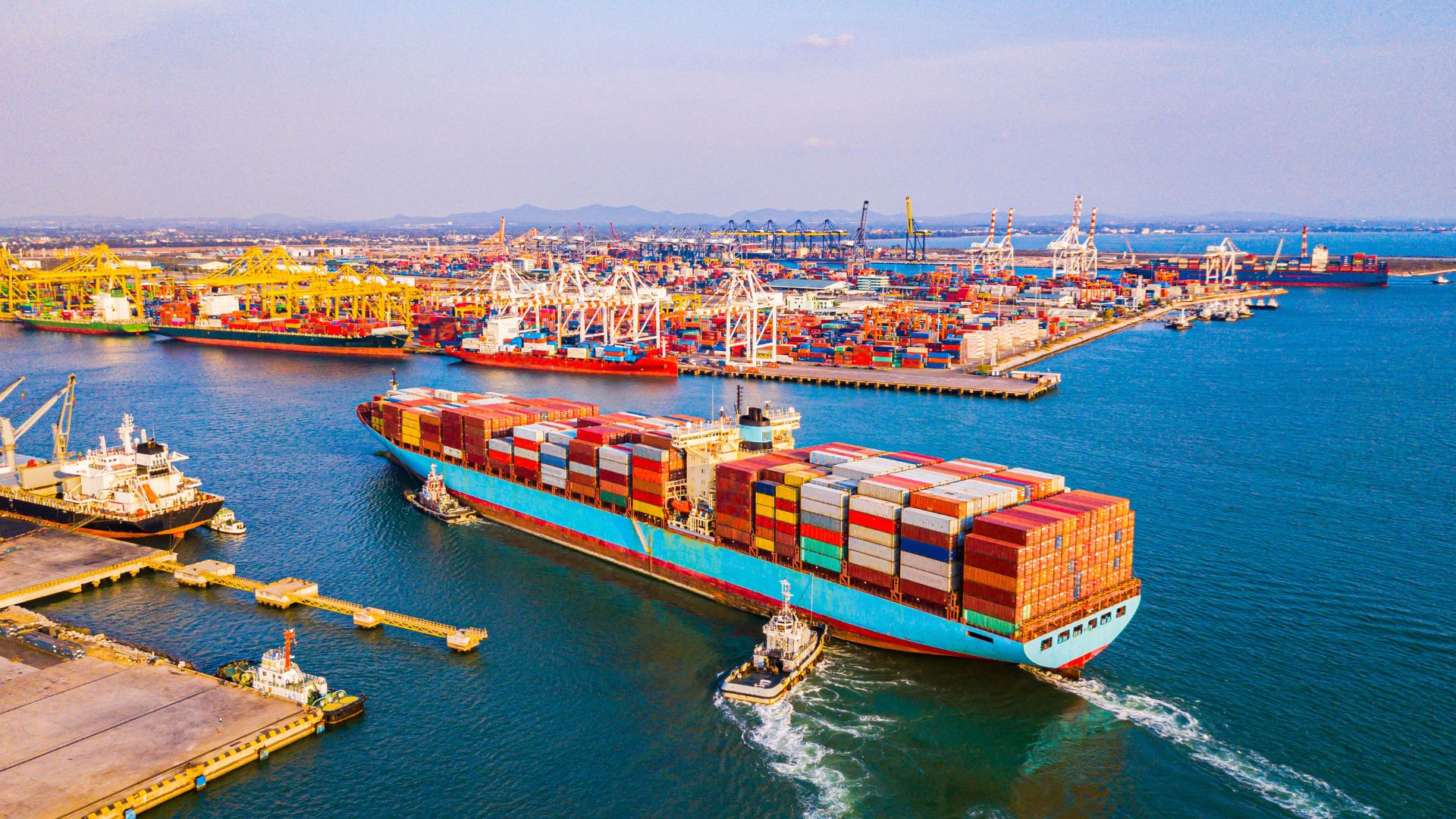
The United States imported $308.4 billion worth of goods from China in 2025 — making China the largest single-country source of US imports, even after a 29.7% drop from 2024 — despite
Next Steps for Importing from China to the US
The regulatory landscape for importing from China to the US has never been more complex — but it is navigable if you approach it in the right sequence. The biggest and most expensive mistakes happen before your goods ship: choosing the wrong supplier, skipping the pre-shipment inspection, or misclassifying your HS code and underestimating your total duty burden.
Here are three concrete next steps:
- Calculate your duty stack first. Use the tariff stacking formula in Section 3 to estimate your MFN + Section 301 + AD/CVD burden for your specific HS code before you commit to any purchase order. The USITC HTS tool at hts.usitc.gov is your starting point.
- Request a landed cost estimate. Contact Easy Imex for a landed cost estimate that includes freight, all applicable duties, and broker fees for your specific product and destination — so your true total cost is visible before you order.
- Address compliance before production. Speak to the Easy Imex team about supplier vetting, UFLPA pre-checks, and pre-shipment inspection for your product category. These steps cost a fraction of what CBP detainment or a product recall costs.
For a complete walkthrough of the entire import process, read our step-by-step import guide.
About the Author: Adam

- 1. The State of US–China Trade in 2026
- 2. What Has Changed for US Importers in 2026?
- 3. How Do Section 301 Tariffs Work and What Do They Cost?
- 4. How to Calculate Your Total Customs Duty from China to the USA
- 5. How to Import from China to the USA: Step-by-Step Process
- Step 1 — Find and Vet a Legitimate Chinese Supplier
- Step 2 — Negotiate Terms, Payment, and a Written Contract
- Step 3 — Develop Samples and Lock In Product Specifications
- Step 4 — Conduct a Pre-Shipment Inspection Before Goods Move
- Step 5 — Choose Your Shipping Method: Sea Freight vs Air Freight
- Step 6 — File Your ISF, Customs Bond, and Clear US Customs
- Step 7 — Arrange Inland Delivery and Confirm Final Landed Cost
- Importing from China to the US — Step-by-Step Checklist
- 6. What Was the De Minimis Rule and Why Does Its Elimination Matter?
- 7. Is China Still Worth It? Comparing China vs. Vietnam, Mexico, and India
- 8. Product Compliance Requirements for US Imports from China
- How Easy Imex Helps You Import from China with Less Risk
- Frequently Asked Questions: Importing from China to the US
- Are there tariffs on orders under $800 from China?
- How much customs duty will I pay from China to the USA?
- What is the Uyghur Forced Labor Prevention Act and how does it affect my imports?
- Do I need a customs broker to import from China?
- What is a customs bond and do I need one?
- Is the US still allowing packages from China?
- Do I have to pay tax if I import goods from China?
- Next Steps for Importing from China to the US
- About the Author: Adam
- Leave A Comment Cancel reply